
Shri Ram Janmabhoomi Mandir, Ayodhya
The temple of Ram Lalla at Ayodhya, run by the Shri Ram Janmbhoomi Teerth Kshetra trust. The Trust publishes free darshan in slots from 7:00 AM to 12:00 PM and 1:00 PM to 9:00 PM, and three aartis, Mangal at 4:00 AM, Shringar at 6:00 AM and Shayan at 10:00 PM, entered by pass. Every pass is free, and the Trust says plainly that there is no paid darshan. What catches people out is what they carry: phones, bags, flowers and prasad.
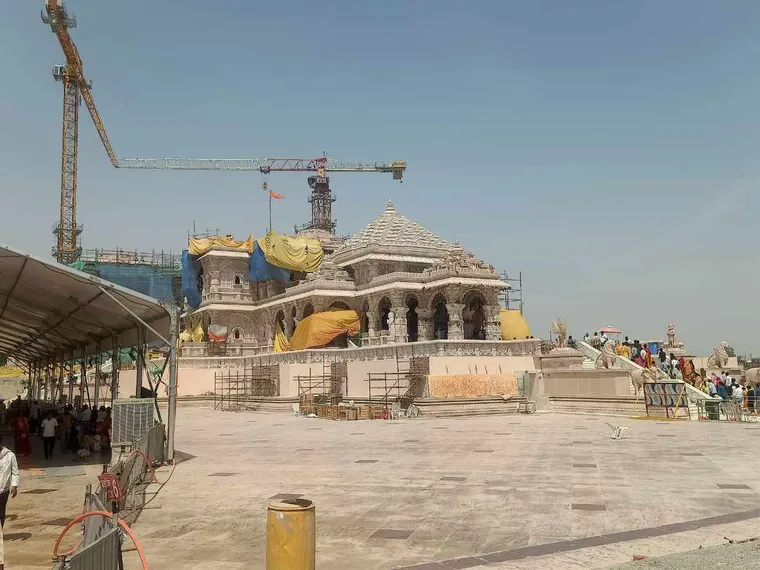
Photo: AmanAgrahari01, CC BY-SA 4.0, resized
Ram Mandir timings in short
Seven free darshan slots across the day, with an hour at midday that has no slot, and three aartis outside them that are entered by pass.
History of Ram Mandir Ayodhya
The temple stands on the former site of the Babri Masjid, a mosque built in 1528 by Mir Baqi, a Mughal commander, on Babur's orders. Many Hindus identify the site as Ram Janmabhoomi, the birthplace of Rama. The first documented religious violence over it came in 1853, and in 1859 the British fenced off the site so that Muslims used the inner court and Hindus the outer one. On the night of 22 to 23 December 1949 idols of Rama and Sita were placed inside the fenced mosque area, and the state took control of the building the following year.
In the 1980s the Vishwa Hindu Parishad launched a campaign to claim the site for a temple to the infant Rama, and a foundation stone was laid beside the disputed land on 9 November 1989. On 6 December 1992 a rally of some 150,000 volunteers organised by the VHP and the BJP tore down the mosque, setting off months of communal violence in which an estimated 2,000 people died in Bombay alone.
In 2019 the Supreme Court awarded the disputed land to a trust to be formed by the Government of India for a temple, and gave Muslims land elsewhere for a mosque. The Shri Ram Janmabhoomi Teerth Kshetra was formed in February 2020, and Prime Minister Narendra Modi performed the bhoomi pujan in August 2020. Ram Lalla's consecration took place on 22 January 2024, the Ram Darbar on the first floor was consecrated on 5 June 2025, and construction was formally marked complete on 25 November 2025 with the hoisting of the Dharma Dhwaja flag on the spire.
- Deity
- Ram Lalla, the infant Rama
- Consecrated
- 22 January 2024
- Architecture
- Nagara style, by the Sompura family
- Size
- 360 ft long, 235 ft wide, 161 ft high
- Columns
- 160 ground, 132 first, 74 second floor
- Stone
- Baansi sandstone, no iron or steel
Why Ram Mandir Ayodhya matters to Hindus
Rama is a principal Hindu deity, regarded as a complete avatar of Vishnu and as the ideal man and the embodiment of dharma. The Ramayana places his birth in Ayodhya on the banks of the Sarayu, and many Hindus believe this temple stands on that exact spot. For that reason the presiding deity is Rama as an infant, Ram Lalla, the name Tulsidas used for the child Rama.
A new image of Ram Lalla was installed in the sanctum as the main deity in 2024, and the Trust has said the Ram Lalla Virajman idol placed at the site in 1949 will now serve as the festival idol. On Ram Navami in 2024, the first after the consecration, the forehead of the idol was anointed at noon with a ray of sunlight, an event known as Surya Tilak.
More facts about Ram Mandir
- Deity
- Ram Lalla, the infant form of Rama
- Where
- Ayodhya, Uttar Pradesh
- Administered by
- Shri Ram Janmbhoomi Teerth Kshetra
- Consecrated
- 22 January 2024
- Architecture
- Maru-Gurjara architecture of the Nagara style, originally designed by the Sompura family of Ahmedabad
- Main temple
- 360 feet long, 235 feet wide, 161 feet high including the peak, three floors
- Temple area
- 2.7 acres, built-up area 57,400 sq. ft., 12 gates
- Also known as
- Ram Mandir Ayodhya, Ayodhya Ram Temple, Shri Ram Janmabhoomi Temple, Ram Lalla temple
Entry rules at Ram Mandir
The Trust's own guidance on what to carry and how passes work. The advice on phones and offerings comes from a notice it posted in March 2024; the pass fee rule is on its site today.
Pass fees
The Trust does not charge any fee for aarti and darshan passes.
Pass instructions
Devotees are asked to follow the instructions printed on the pass carefully.
Booking
Free aarti, free Sugam Darshan and free Samanya Darshan are listed on the Trust's booking portal, which asks devotees to log in. The Trust authorises no agents for online bookings.
Phones and belongings
The Trust has advised devotees to leave mobile phones, footwear, purses and other items outside the temple premises, saying this saves time.
Offerings
The Trust has asked devotees not to bring flowers, garlands, prasad and similar items to the temple.
Aarti pass details
In its 2024 notice the Trust said an aarti entry pass needs the devotee's name, age, Aadhaar card, mobile number and city.
Paid darshan
The Trust has said there is no arrangement for darshan or a special pass for a fixed fee, and that anyone offering darshan for money may be attempting fraud.
Wheelchairs
Available at the temple for elderly and differently-abled devotees within the temple premises. There is no rental fee, but the young person pushing the wheelchair is to be paid.
How to reach Ram Mandir Ayodhya
By air
Ayodhya's own airport, officially Maharshi Valmiki International Airport, opened for commercial flights on 10 January 2024. It is 14.8 km from Ayodhya station and 6.8 km from Faizabad station.
By train
Ayodhya Dham Junction, station code AY, is 1.2 km south-east of the Ram Mandir, on the Lucknow to Ayodhya to Varanasi line. The other main station is Ayodhya Cantt.
By road
The Trust says Uttar Pradesh Transport Corporation buses run 24 hours a day, and gives Ayodhya as about 130 km from Lucknow, 140 km from Gorakhpur, 160 km from Allahabad, 200 km from Varanasi and 636 km from Delhi.
Best time to visit Ram Mandir Ayodhya
Ayodhya has a humid subtropical climate. Summers are long, dry and hot from late March to mid-June, with average daily temperatures near 32 °C, and the monsoon follows until October. Winter runs from early November to the end of January with average temperatures near 16 °C and colder nights, followed by a short spring in February and early March. Winter and spring are the mildest months for standing in a darshan queue outdoors.
Special days change the temple's routine. The first Ram Navami after the consecration, in 2024, brought the noon Surya Tilak, and the Trust has altered its schedule before, closing the temple for a lunar eclipse on 7 September 2025 and reopening at the next morning's Mangal Aarti. Check the Trust's site and its X account close to any festival or eclipse date.
Within the day, the Trust publishes free darshan slots from 07:00 to 12:00 and 13:00 to 21:00, and all passes are free, so the choice of slot comes down to your travel plans and availability on the booking portal.
Tips before you go
- Book your free darshan or aarti pass on the Trust's own portal; the Trust authorises no agents and charges no fee.
- Read the instructions printed on your pass carefully before you arrive, as the Trust asks.
- Leave mobile phones, footwear and purses outside the temple premises, which the Trust says saves time.
- Do not bring flowers, garlands or prasad; the Trust has asked devotees not to.
- Treat anyone offering darshan for money as a possible fraud; the Trust sells no paid darshan.
- Wheelchairs are available free inside the premises for elderly and differently-abled devotees, though the person pushing is to be paid.
A temple still opening up around itself
The main temple was consecrated in January 2024, but the complex around it has kept opening in stages.
The main temple
The Trust gives the main temple as 360 feet long, 235 feet wide and 161 feet high including the peak, on three floors of 20 feet each, with 12 gates and 160 columns on the ground floor alone.
Ram Lalla's consecration, the prana pratishtha, took place on 22 January 2024. Construction was formally marked complete on 25 November 2025 with the hoisting of a flag on the temple's peak.
The rest of the premises
On Monday 13 April 2026 the Trust announced that darshan had begun at all temples and mandaps within the Shri Ram Janmabhoomi premises, with devotees admitted in regulated numbers through a pass system.
The Trust lists Ayodhya Junction and Faizabad Junction as the railway stations, Gorakhpur airport at 118 km and Lucknow's Amausi airport at 125 km, and Uttar Pradesh transport buses running 24 hours a day.
Not verified yet 6 items no official source publishes
- Whether the phone, bag and offerings guidance from the Trust's 2024 notice has changed. It is the latest Trust statement on the subject this site found, but it is not current-dated.
- Where the cloak room or lockers are, what they cost and when they open.
- A dress code. The Trust does not publish one on the pages read here.
- Whether general darshan is possible without booking a slot pass in advance. The portal requires login to see the conditions.
- What documents the current pass requires. The 2024 notice named Aadhaar, but the present requirement has not been verified.
- The difference between Free Sugam Darshan and Free Samanya Darshan on the booking portal.
Know one of these from an official notice? Send it to us and the page is updated with a new date.
Questions about visiting
Answered from what the temple publishes, with the gaps left as gaps.
What are the Ram Mandir Ayodhya timings?
The Trust publishes free darshan slots from 7:00 AM to 12:00 PM and from 1:00 PM to 9:00 PM, and aartis at 4:00 AM, 6:00 AM and 10:00 PM. It says these timings appear in booking receipts from 18 April 2026.
Is darshan at Ram Mandir free?
Yes. The Trust states it does not charge any fee for aarti and darshan passes, and has said there is no special pass sold for a fixed fee.
Is there VIP or paid darshan?
The Trust has said there is no darshan or special pass for a fixed fee, and that anyone offering darshan for money may be attempting fraud. It has no connection with such offers.
How do I get an aarti pass?
Through the Trust's booking portal, online.srjbtkshetra.org, which lists free aarti passes and asks devotees to log in. The Trust authorises no agents to book on your behalf.
Can I take my phone into Ram Mandir?
The Trust has advised devotees to leave mobile phones, footwear, purses and other items outside the temple premises. Where to deposit them has not been verified here.
Can I bring flowers or prasad?
No. The Trust has asked devotees not to bring flowers, garlands, prasad and similar items to the temple.
Is there a dress code?
The Trust does not publish one on the pages this site read, so no dress rule is reported here. Modest dress is the safe choice.
Are wheelchairs available?
Yes. The Trust has said wheelchairs are available for elderly and differently-abled devotees inside the temple premises, with no rental fee, though the person pushing is to be paid.
Can I visit the other temples in the complex?
The Trust announced on 13 April 2026 that darshan had begun at all temples and mandaps in the premises, with entry in regulated numbers through passes.
How big is the temple?
The Trust gives the main temple as 360 feet long, 235 feet wide and 161 feet high including the peak, on three floors, with 12 gates.
How do I reach Ayodhya?
The Trust lists Ayodhya Junction and Faizabad Junction railway stations, Gorakhpur airport at 118 km and Lucknow airport at 125 km, and says the city is about 130 km from Lucknow.
Can I rely on older timings I have seen?
No. The Trust has changed its schedule several times since 2024, and its current list dates from April 2026. Check its home page for your date.
Need the timings in full?
The timings page carries the whole published schedule, block by block, and what to check before you travel.