
Shree Jagannatha Temple, Puri
One of the four Char Dham sites, on the Odisha coast, run by the Shree Jagannath Temple Administration. The temple opens with Dwaraphita at about 4.30 A.M. and the day runs as a sequence of named rituals until Pahuda at 11.30 at night. Two facts decide whether a visit is possible at all: non-Hindus are not permitted to enter, and shoes, leather articles, cameras and mobile phones are not allowed inside.
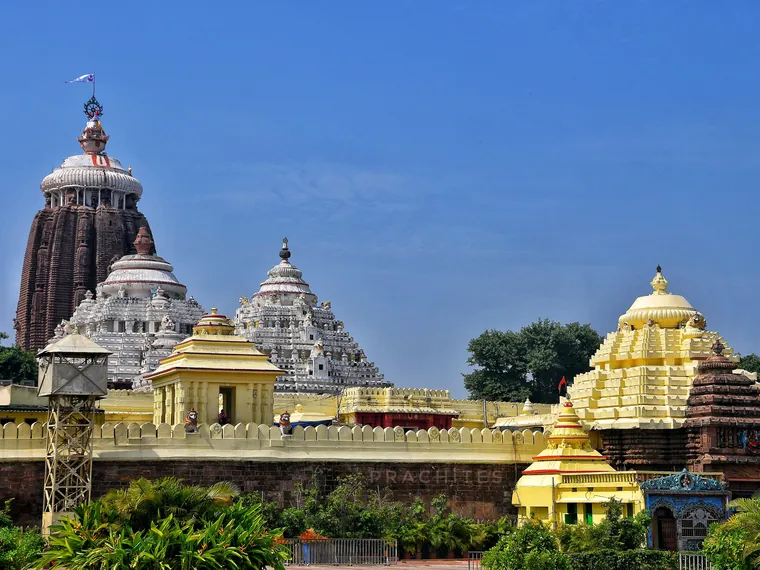
Photo: Subham9423, CC BY-SA 4.0
Jagannath Puri timings in short
The administration publishes the ritual day in full and, separately, the windows in which darshan is and is not available. The second list is the one a visitor needs.
History of Jagannath Temple Puri
Puri was sacred long before the present temple. The Skanda Purana has a section in praise of Purushottama Kshetra, as Puri was known, and an 11th-century play already mentions a shrine of Purushottama there. Temple tradition, recorded in the Madala Panji chronicle, credits a legendary King Indradyumna with building the first temple.
The present temple is universally accepted as the work of King Anantavarman Chodaganga Deva, founder of the Eastern Ganga dynasty, in the 12th century. The temple administration records that although construction was almost complete in his reign, it was left unfinished for a long time, and Anangabheema Deva III completed it in 1230 and installed the deities. Anangabheema regarded Jagannatha as the true ruler of his empire and called himself the deity's subordinate, an attitude later Ganga kings kept up.
In 1568 the Afghan general Kalapahar attacked the temple after the defeat of the Gajapati ruler Mukunda Deva. The treasury was looted, and the wooden images of Jagannath, Balabhadra and Subhadra were taken out and burned. Ramachandra Deva I of Khurda re-established worship and commissioned new images, which were installed in 1575, the first Nabakalevara. The Madala Panji records that the temple was invaded 18 times in all.
The temple was declared a National Monument in 1975, and under an agreement of 22 August 1979 its conservation was entrusted to the Archaeological Survey of India.
- Built
- 12th century; completed 1230
- Architecture
- Kalinga style, Pancharatha rekha deula
- Height
- 65 m (214 ft)
- Site
- About 10 acres
- National Monument
- Declared in 1975
- Pilgrimage
- One of the four Char Dhams
Why Jagannath Temple Puri matters to Hindus
Puri is one of the four Dhams, the most sacred pilgrimage places for Hindus, alongside Badrinath, Dwarka and Rameswaram. The temple administration notes that Adi Shankaracharya named these four and installed his senior disciple, Padmapada, as the first head of the Govardhan Peeth at Puri. Scriptures such as the Skanda Purana describe Puri as the very body of the Lord, and the town also carries names such as Shankha-kshetra, Neelachala and Martya-Vaikuntha.
The deities are Jagannath, a form of Vishnu identified with Krishna, his elder brother Balabhadra and their sister Subhadra, with Sudarshan. Unlike the stone or metal images of most Hindu temples, they are carved from neem wood and are replaced in the Nabakalebara ritual. Many Vaishnava saints were closely associated with the temple, among them Ramanujacharya, Madhvacharya, Nimbarkacharya and Chaitanya Mahaprabhu, who lived in Puri for many years. The poet Jayadeva's Gitagovinda is sung before Jagannatha, and the temple's food offerings, the Mahaprasad, are all vegetarian and cooked without onion or garlic.
More facts about Jagannath Puri
- Deities
- Jagannath, Balabhadra and Subhadra
- Where
- Puri, Odisha
- Administered by
- Shree Jagannath Temple Administration
- Main tower
- 65 metres (214 ft) above the inner sanctum
- Four gates
- Singhadwara or Lion Gate facing east, Hathidwara north, Vyaghradwara south and Ashwadwara west
- Ratha Yatra
- The deities travel to the Gundicha Temple about 3 km away, returning on the concluding day, Niladri Bije
- Jagannath's chariot
- Approximately 14 metres (45 ft) high and 11 metres (35 ft) wide
- Kitchen
- The second largest in the world, preparing fifty-six varieties, all vegetarian and without onions or garlic
- Also known as
- Shree Jagannatha Temple, Puri Jagannath Temple, Jagannath Mandir, Shri Mandir
Entry rules at Jagannath Puri
The entry rule at Puri is the strictest of any temple on this site, and it is the first thing to establish before booking travel.
Who may enter
Non-Hindus, excluding Jains, Sikhs and Buddhists, and foreigners are not permitted to enter the temple.
General entry
General devotees enter through Lion's Gate. Officials, sevaks and citizens of Puri town can enter through any gate with ID proof.
Prohibited items
Shoes, sandals, leather articles, cameras and mobile phones. Free stands are provided at Lion's Gate.
Accessibility
Battery-operated vehicles, wheelchairs, ramps and free first aid are available for elderly and disabled devotees.
Jagannath Puri dress code
The administration publishes no dress code on the pages this site reads. What it does publish is a strict list of what may not come in.
- Shoes, sandals and leather articles are not allowed inside the temple. Free stands are provided at Lion's Gate.
- Cameras and mobile phones are not allowed inside the temple.
- No dress code is published by the administration on the pages this site reads.
How to reach Jagannath Temple Puri
By air
Puri has no airport. The nearest is Biju Patnaik International Airport in Bhubaneswar, 60 km away.
By train
Puri is a terminus on the East Coast Railway, with direct trains to New Delhi, Mumbai, Kolkata, Okha, Ahmedabad and Tirupati. Khurda Road station, 44 km from Puri, is the convenient railhead for trains to Chennai and western India.
By road
The bus stand near the Gundicha Temple has buses to Bhubaneswar and Cuttack every 10 to 15 minutes, minibuses to Konark every 20 to 30 minutes, and direct buses to Kolkata and Visakhapatnam.
Best time to visit Jagannath Temple Puri
The single most important date to plan around is the Anasara period. After the Snana Yatra on the full moon of Jyestha, around early June, the deities are kept away from public view and the temple administration states that darshan is not possible for 15 days. Arriving then means reaching Puri at the one time of year the deities cannot be seen in the temple.
Ratha Yatra, on the second day of the bright fortnight of Ashadha, usually in June or July, is the most famous festival of the year. The deities leave the temple in three huge chariots for the Gundicha temple about 3 km away and return on the tenth day of the same fortnight. It is a spectacular time to be in Puri, but the deities are in the chariots and at Gundicha rather than on the ratnavedi in the main temple.
Outside those weeks, the temple's twelve traditional festivals, the dvadasa yatras, spread through the year. Within the day, the administration publishes darshan from 05:30 after Mangala Alati, a gap of about an hour and a quarter in the morning, and further windows in the afternoon and evening.
Tips before you go
- Check you are eligible to enter before you travel: the administration states only Hindus are allowed inside.
- Leave umbrellas, mobile phones, electronic gadgets and leather items behind; none may be carried.
- Bathe and wear clean clothes before entering the shrine, as the administration asks.
- Keep silent inside the temple and follow the queue system.
- Do not carry cooked food, and do not come having consumed liquor or other intoxicants.
- Watch out for pickpockets and monkeys, which the administration warns about.
Not verified yet 6 items no official source publishes
- Exact darshan start and end times for each window. The administration publishes them loosely, with phrases like "onwards" and "until around 11 A.M."
- How entry eligibility is checked at the gate, and what documentation is asked for.
- Whether any dress code is enforced. The administration publishes none.
- What happens to the schedule during Ratha Yatra, when the deities are not in the temple.
- Mahaprasad: where it is sold in the Ananda Bazar, at what price, and during which hours.
- Whether the paid or special darshan queues that exist elsewhere operate here, and at what cost.
Know one of these from an official notice? Send it to us and the page is updated with a new date.
Questions about visiting
Answered from what the temple publishes, with the gaps left as gaps.
Can non-Hindus enter Jagannath Temple?
No. Non-Hindus, excluding Jains, Sikhs and Buddhists, and foreigners are not permitted to enter the temple. This is the fact most worth establishing before booking travel to Puri, and it is not negotiable at the gate.
What time does the temple open?
The administration publishes Dwaraphita, the opening of the doors of the sanctum, at about 4.30 A.M. Darshan is listed as available from 5.30 A.M. onwards, after Mangal Alati.
When is darshan not available?
The administration states that darshan of Shree Jagannatha Mahaprabhu is not available for one hour and fifteen minutes in the morning, which falls at roughly 8 to 9.15 A.M.
Can I take my phone inside?
No. The administration states that shoes, sandals, leather articles, cameras and mobile phones are not allowed inside the temple. Free stands are provided at Lion's Gate.
Which gate do I enter by?
General devotees use Lion's Gate, the Singhadwara, which faces east. Officials, sevaks and citizens of Puri town may enter through any gate with ID proof.
Is there a dress code?
The administration publishes none on the pages this site reads. That is not the same as there being none, and this page will not report a rule the temple has not stated.
What are the four gates?
Singhadwara or Lion Gate facing east and used by general devotees, Hathidwara or Elephant Gate to the north, Vyaghradwara or Tiger Gate to the south, and Ashwadwara or Horse Gate to the west.
What happens during Ratha Yatra?
The three deities travel to the Gundicha Temple about 3 km away in chariots, Jagannath's standing roughly 14 metres high and 11 metres wide, and return on the concluding day, Niladri Bije. The temple's ordinary schedule does not apply.
What is the temple kitchen?
The second largest in the world. It prepares fifty-six varieties of food, all vegetarian and made without onions or garlic. Where and how Mahaprasad is sold has not been verified here.
Is there help for elderly or disabled visitors?
The administration lists battery-operated vehicles, wheelchairs, ramps and free first aid for elderly and disabled devotees. Booking conditions for any of those have not been verified here.
How tall is the temple?
The main tower rises 65 metres, about 214 feet, above the inner sanctum where the deities reside.
Can I rely on these timings?
Read them as the shape of the day. The administration publishes several rituals without clock times and describes the darshan windows approximately, so precision beyond what is above should come from the temple itself.
Need the timings in full?
The timings page carries the whole published schedule, block by block, and what to check before you travel.