
Prambanan Temple Compounds
The largest Hindu temple compound in Indonesia, built in the 9th century for the Trimurti of Shiva, Brahma and Vishnu, and a UNESCO World Heritage Site since 1991. It is run as a ticketed heritage park by InJourney Destination Management, which publishes the temple area as open 07:00 to 17:30 WIB with the ticket counter open 06:30 to 17:00. The fact most worth knowing before you go is that on Mondays the three main temples are closed for maintenance, while the rest of the park stays open.
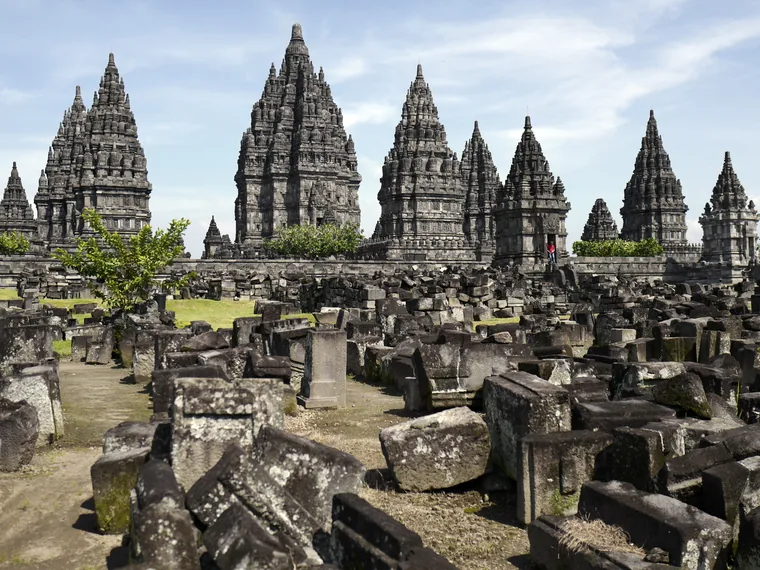
Photo: Christopher Michel, CC BY-SA 4.0
Prambanan opening hours in short
One daily window for the temple area, a counter that opens earlier and shuts earlier, and one weekly exception that removes the main temples from the visit.
History of Prambanan Temple
Prambanan was built in the mid-9th century by the Sanjaya dynasty of the ancient Mataram kingdom, the operator's history page says. Wikipedia adds that construction was probably begun by Rakai Pikatan, whose name was found painted in red on a finial of the Shiva temple, and that the Shivagrha inscription of 856 CE describes the inauguration of a Shiva temple on 12 November 856. Its original name was Shiva-grha, the House of Shiva. Later kings, including Lokapala and Balitung, enlarged the compound until it held 240 temples.
For about 80 years Prambanan was the royal temple of Mataram. Then, around the middle of the 10th century, it was abandoned. Wikipedia notes that in the 930s the court moved to East Java under Mpu Sindok, perhaps because of an eruption of Mount Merapi or a power struggle. The temples fell into ruin and collapsed in a major earthquake in the 16th century, though local people never forgot the site and told the legend of Rara Jonggrang to explain it.
European interest began in the 18th and 19th centuries. A VOC employee, Cornelis Antonie Lons, described the ruins in 1733. Colin Mackenzie, working for Thomas Stamford Raffles, came across them in 1811 during the brief British occupation of Java. For decades afterwards, sculptures were carried off and stones taken for building, until the Dutch colonial government began reconstruction in 1918.
The main Shiva temple was finished in 1953 and inaugurated by President Sukarno. The Brahma temple followed between 1978 and 1987 and the Vishnu temple between 1982 and 1991, and by 1993 all the main temples were standing again. Prambanan became a UNESCO World Heritage Site in 1991. It was damaged in the 2006 Yogyakarta earthquake and reopened some weeks later. Restoration of the 224 smaller pervara temples continues, and as of February 2023 only six had been fully rebuilt.
- Built
- Mid-9th century, Sanjaya dynasty
- Inaugurated
- 12 November 856 (Shivagrha inscription)
- Main temple
- Shiva temple, 47 metres tall
- Dedicated to
- Shiva, Brahma and Vishnu
- UNESCO
- World Heritage Site since 1991
- Original extent
- 240 temples
Why Prambanan matters to Hindus
Prambanan is dedicated to the Trimurti: Shiva, the main deity, with Brahma and Vishnu. Wikipedia describes it as the largest Hindu temple site in Indonesia and the second largest in Southeast Asia after Angkor Wat. The Shiva temple, 47 metres tall, holds statues of Shiva and, in its smaller chambers, Durga, the sage Agastya and Ganesha. Facing the three main temples are three temples for the gods' mounts: Nandi, Garuda and Hamsa.
Legend gives the temple its popular name. In the Javanese story of Rara Jonggrang, Prince Bandung Bondowoso wants to marry the princess, who sets him the task of building a thousand temples in one night. With spirits helping him, he finishes 999 before she tricks the spirits into thinking dawn has come. Furious, he turns her to stone, and she becomes the thousandth statue: the image of Durga in the north chamber of the Shiva temple, still called Rara Jonggrang, the slender maiden.
Prambanan is not only a monument. Since the main temples were rebuilt, Balinese and Javanese Hindus have revived annual ceremonies here, including Galungan, Tawur Kesanga and Nyepi. In November 2019 a grand Abhiseka ceremony, the first in 1,163 years, was held to purify the temple and mark its return as a centre of worship, and each year the Siwaratri celebration draws thousands of devotees for a night of prayer.
More facts about Prambanan
- Dedicated to
- The Trimurti: Shiva, Brahma and Vishnu
- Built
- Mid-9th century, by the Sanjaya dynasty of the ancient Mataram kingdom
- Main temple
- Shiva temple, 47 metres tall
- Where
- Bokoharjo, Prambanan, Sleman Regency, Special Region of Yogyakarta, on the border with Klaten Regency, Central Java
- Operator
- InJourney Destination Management (PT Taman Wisata Candi Borobudur, Prambanan dan Ratu Boko)
- World Heritage
- Inscribed by UNESCO in 1991 as the Prambanan Temple Compounds
- Original extent
- 240 temple structures
- Visitors
- More than 2 million a year, according to the operator
- Also known as
- Candi Prambanan, Prambanan Temple Compounds, Rara Jonggrang, Loro Jonggrang temple
Entry rules at Prambanan
Published by InJourney Destination Management on its own article, ticket and destination pages. Prices are the ones it printed on 29 July 2026 and are in Indonesian rupiah.
Monday closure
The main temple areas (Brahma, Shiva and Vishnu) are closed on Mondays for routine maintenance and cleaning. Visitors can still enter the courtyard beyond them and the Sewu, Lumbung and Bubrah temples.
Domestic visitors, weekdays
Adults over 10 Rp50,000; children aged 3 to 10 Rp25,000; students Rp25,000.
Domestic visitors, weekends
Adults over 10 Rp65,000; children aged 3 to 10 Rp35,000; students Rp35,000.
International visitors
Adults Rp400,000; children Rp250,000, the same on weekdays and weekends.
What the ticket includes
Access to Prambanan Temple, Lumbung Temple, Bubrah Temple, Sewu Temple and the Prambanan Museum.
Buying tickets
Tickets are sold online on the operator's official ticket site as well as at the counter.
Museum
Entry to the Prambanan museum is free.
Closures for events
The operator restricts access at short notice for state events. On 7 and 8 July 2026 visitors were limited to Sewu, Lumbung and Bubrah temples and the Siwa field, entering through the Sewu gate in Klaten.
How to reach Prambanan Temple
By train
Brambanan Station, in Klaten Regency, is about 750 metres south-east of the temple compound and is served by KAI Commuter's Yogyakarta Line.
By road
The operator gives the address as Jl. Raya Yogya-Solo KM 16, Prambanan, Sleman, Special Region of Yogyakarta.
By road
The temple is about 17 km north-east of Yogyakarta city, just north of the Yogyakarta to Solo highway.
By road
The Prambanan bus terminal nearby is the end of the Trans Jogja K3S bus line.
Best time to visit Prambanan
Pick a day other than Monday. On Mondays the three main temples of Shiva, Brahma and Vishnu are closed for routine maintenance and cleaning, and only the courtyard and the Sewu, Lumbung and Bubrah temples are open. The operator publishes the temple area as open from 07:00 to 17:30 WIB, with the ticket counter open from 06:30 to 17:00.
Within the day, the operator suggests two times. To avoid the strongest sun, come in the morning. For the sunset, it recommends arriving from about 3 p.m. Either way, the operator suggests allowing two to three hours for the whole site.
Hindu festival days change the feel of the site. The Siwaratri celebration opens the Prambanan Shiva Festival, which in 2026 ran from 17 January to the Maha Shivaratri ceremony on 15 February. Nyepi, Galungan and Tawur Kesanga ceremonies are also held here. These are the days to see Prambanan as a place of worship. No special opening hours for them are published, so check the operator's notices first.
Tips before you go
- Avoid Mondays if you want to enter the three main temples, which close that day for maintenance.
- Buy tickets online on the operator's official ticket site so a late arrival is not caught out when the counter closes at 17:00.
- One ticket covers Prambanan, Lumbung, Bubrah and Sewu temples and the Prambanan Museum.
- Walk round the Shiva temple clockwise, starting from the east stairs, to follow the Ramayana reliefs in order.
- Allow two to three hours for the whole site.
- Check the operator's channels before a long journey. Access was restricted at short notice for a state visit in July 2026.
Visiting a heritage park that is still a place of worship
Prambanan is run like a museum site, with a gate, a ticket and zones, but it has also become a centre of Hindu ceremony in Java again since the main temples were rebuilt.
What you are looking at
The operator describes three courtyards in tiers. The innermost and most sacred holds the three main temples of Shiva, Brahma and Vishnu; the middle one was once filled with hundreds of smaller ancillary temples, most now in ruins; the outer one is the largest and holds few structures.
The Shiva temple is the main building and stands 47 metres tall. Panels on the temple bodies carry the Ramayana, which is why the reliefs repay a slow walk rather than a photograph from the lawn.
Why the numbering of zones confuses people
The operator's own pages number the zones in opposite directions. Its destination page calls the outer yard Zone 1, while its article on opening hours calls the inner court with the main temples Zone 1 and says Zone 2 stays open on Mondays.
Read the Monday rule by name rather than number: the three main temples are closed, the courtyard around them and the other temples are open.
A living religious site
Since the main temples were reconstructed in the late 20th century, Balinese and Javanese Hindu communities have revived annual ceremonies here, including Galungan, Tawur Kesanga and Nyepi. A grand Abhiseka ceremony was held in November 2019.
In 2026 the Prambanan Shiva Festival ran from 17 January to the Maha Shivaratri ceremony on 15 February. On days like those the site is not only a tourist park, and ordinary access may be arranged differently.
On the provincial border
The compound lies about 17 km north-east of Yogyakarta city, on the boundary between the Special Region of Yogyakarta and Central Java. The main temple sits in Sleman Regency, Yogyakarta, while part of the wider park and the Sewu temple gate lie in Klaten Regency, Central Java.
The Opak River and the temple ruins were used to mark the border between the Yogyakarta and Surakarta sultanates after 1755, and that line became the provincial border that runs through the area today.
Not verified yet 6 items no official source publishes
- A dress code. The operator publishes none on the pages read here. Prambanan is a Hindu religious site, so modest clothing is sensible, but no rule is quoted.
- Whether visitors may climb or enter the main temples, and under what conditions. This is widely reported but was not found on an official page.
- Rules on outside food and drink, drones, tripods and large bags.
- The current Ramayana Ballet schedule. Two official pages give different days: one lists Tuesday, Thursday, Friday and Saturday from 17:30 to 19:30, the ticket site lists Ramayana on Tuesday, Thursday and Saturday with Roro Jonggrang on Friday, for May to October 2025.
- Combined tickets with Borobudur or Ratu Boko, and their current prices.
- Whether prices change on public holidays in addition to the weekday and weekend rates.
Know one of these from an official notice? Send it to us and the page is updated with a new date.
Questions about visiting
Answered from what the temple publishes, with the gaps left as gaps.
What are the Prambanan Temple opening hours?
InJourney Destination Management, which runs the site, publishes the temple area as open 07:00 to 17:30 WIB and the ticket counter as open 06:30 to 17:00. Its ticket page gives 06:30 as the start time every day.
Is Prambanan closed on Mondays?
Not entirely. On Mondays the main temple area with the Shiva, Brahma and Vishnu temples is closed for routine maintenance and cleaning. The park, the courtyard beyond the main temples and the Sewu, Lumbung and Bubrah temples stay open.
How much is the ticket?
On the operator's figures of 29 July 2026: Indonesian adults Rp50,000 on weekdays and Rp65,000 at weekends; foreign adults Rp400,000 and foreign children Rp250,000 on any day. Children aged 3 to 10 and students pay less on the domestic rate.
What does the ticket include?
The operator's ticket page lists access to Prambanan Temple, Lumbung Temple, Bubrah Temple, Sewu Temple and the Prambanan Museum. Entry to the museum itself is free.
Can I buy tickets online?
Yes. The operator sells tickets on its official ticket site, ticket.injourneydestination.id, as well as at the counter. Buying online avoids the risk of the counter closing at 17:00 before you arrive.
Is there a dress code?
Not verified here. The operator does not publish one on the pages this site reads. Prambanan is a Hindu religious site where ceremonies are still held, so dressing modestly is the sensible default.
Can I climb the temples?
Not verified here. Restrictions on entering or climbing the main temples are widely reported, but this site did not find them stated on an official page, so it does not repeat them as fact.
How long should I allow?
The operator suggests about two to three hours to explore the whole site, which it gives as about 80 hectares: roughly an hour for the main compound and an hour for the three surrounding temples.
Is Prambanan in Yogyakarta or Central Java?
On the border of both. The main compound is in Sleman Regency in the Special Region of Yogyakarta, while part of the park, including the Sewu temple gate, is in Klaten Regency, Central Java. It is about 17 km north-east of Yogyakarta city.
Is Prambanan still used for worship?
Yes. Since the main temples were rebuilt, Hindu communities hold annual ceremonies there including Galungan, Tawur Kesanga and Nyepi, and in 2026 a Shiva festival ran up to Maha Shivaratri on 15 February.
Can the site close without warning?
It can be restricted at short notice. For a state visit on 8 July 2026 the operator limited access to Sewu, Lumbung and Bubrah temples and the Siwa field on 7 and 8 July. Check the operator's channels before a long journey.
When is the Ramayana Ballet?
Not verified here, because the operator's own pages disagree on which days it runs. Check the Ramayana Ballet page on the official ticket site for the date you want.
Need the opening hours in full?
The opening hours page carries the whole published schedule, block by block, and what to check before you travel.