
Sri Mariamman Temple, Singapore
Singapore's oldest Hindu temple, founded in 1827 on South Bridge Road in Chinatown and dedicated to the goddess Mariamman. It is run by the Hindu Endowments Board and is a gazetted National Monument. The temple's own site gives operating hours of 06:00 to 12:00 and 18:00 to 21:00, with Friday evenings running to 21:15. On those hours it is closed through the afternoon, so an afternoon walk through Chinatown will find the gopuram but not an open temple.
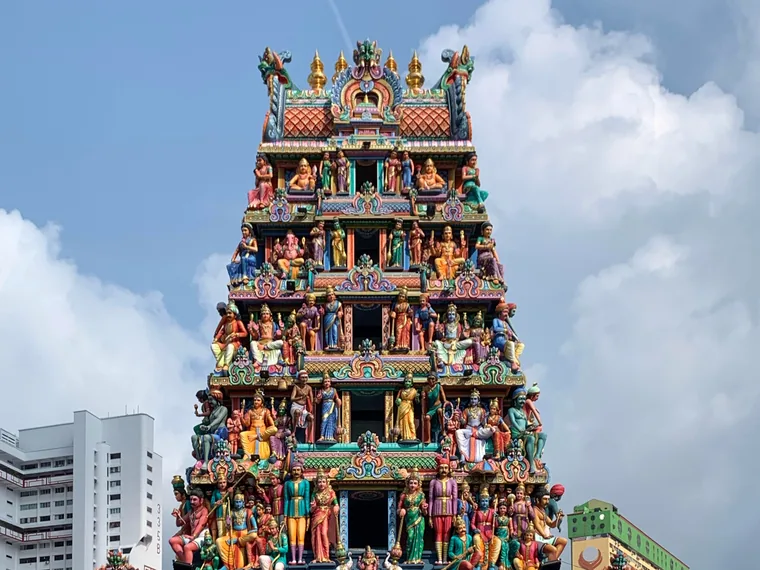
Photo: Chainwit., CC BY-SA 4.0, cropped to 4:3 from the top of the original, resized
Sri Mariamman opening hours in short
Two windows a day with a long afternoon closure between them, a later close on Fridays, and a pooja schedule that runs on slightly different times.
History of Sri Mariamman Temple, Singapore
Sri Mariamman Temple was built in 1827 for worship by immigrants from the Nagapatnam and Cuddalore districts of South India, and was popularly known at the time as Mariamman Kovil or Kling Street Temple. Its founder, Naraina Pillai, was a clerk with the East India Company in Penang who came to Singapore with Sir Stamford Raffles in 1819, set up the island's first brick kiln and became a leader of the Indian community.
The first temple, of wood and attap, was replaced by a plaster and brick building in 1843. The National Heritage Board notes that the grant of the site was written into Singapore's first town plan, drawn up by Lieutenant Philip Jackson, and that a fire in 1910 destroyed the attap-covered walkway, replaced in 1915 by a sheltered walkway designed by Swan & Maclaren.
The gopuram over the entrance has been rebuilt more than once. The temple's own history says the original, from the late 1800s, carried little ornament, was rebuilt in the 1930s and was restored with its dense sculpture in the 1960s, while the National Heritage Board dates the replacement of the earlier three-tiered tower to 1925. In 1962 a new temple structure was completed with sculptural work in the style of temple architecture in India.
The first recorded kumbabishegam, the consecration ceremony, was held in June 1936, followed by others in June 1949, on 6 June 1971, 6 September 1984 and 19 May 1996. The temple was gazetted as a National Monument on 6 July 1973, reconsecrated in 2010 after a year-long restoration, and most recently consecrated at a Maha Kumbabishegam on 12 February 2023.
- Founded
- 1827, by Naraina Pillai
- Status
- National Monument since 6 July 1973
- Architecture
- Dravidian, with an entrance gopuram
- Presiding deity
- Mariamman
- Main festival
- Theemithi, October or November
- Last consecration
- 12 February 2023
Why Sri Mariamman Temple matters to Hindus
The presiding deity is Mariamman, a South Indian mother goddess whom the temple describes as known for her power in curing epidemic illnesses and diseases; the National Heritage Board adds that she is associated with life-giving rain. The small image of her that Naraina Pillai installed in 1827, known as Sinna Amman, is still in the main sanctum, so worship here runs in an unbroken line back to the temple's founding.
Among the other shrines is one to Draupadi, the heroine of the Mahabharata, who is at the centre of Theemithi, the temple's main festival. Held every year in October or November, it honours her with a procession of about four kilometres and a ceremony in which devotees walk barefoot across burning charcoal. The temple names Navarathiri and the 1008 Sankabishegam as its other important festivals.
More facts about Sri Mariamman
- Deity
- Mariamman, known for her power in curing epidemic illnesses and diseases
- Founded
- 1827, by Naraina Pillai
- Address
- 244 South Bridge Road, Singapore 058793
- Managed by
- Hindu Endowments Board
- Status
- National Monument, gazetted on 6 July 1973
- Oldest brick structure
- Around 1843
- Main festival
- Theemithi, the firewalking ceremony, held annually in October or November
- Last consecration
- Maha Kumbabishegam on 12 February 2023
- Also known as
- Mariamman Kovil, Kling Street Temple, Sri Mariamman Temple Chinatown, Singapore Hindu temple South Bridge Road
Entry rules at Sri Mariamman
The etiquette page also sets out how to behave inside, and it is more specific than most temples manage.
Shrines
Please do not enter the shrines or sanctums.
Sitting
Do not sit with feet pointing toward the deities, the priests or another person.
Affection
Hugging and other demonstrations of affection between adults are not appropriate.
Noise
Refrain from talking loudly, and treat the priests with respect.
Smoking and alcohol
Prohibited in the temple and temple grounds.
Booked services
Services can be booked online at least 48 hours in advance; shorter notice goes through the temple administrator.
Sri Mariamman dress code
Published by the Hindu Endowments Board on the temple's etiquette page, quoted closely.
- Shoulders must be covered, which is easily done with a scarf or a shawl.
- Trousers or skirts must cover at least the knees.
- It is best to avoid anything too tight, too short and too revealing; generally it is better to wear too much rather than too little.
- For those who are not appropriately dressed, temples do provide shawls, cover-ups and wraps.
- Footwear should be removed outside the temple, where a space is designated for it.
How to reach Sri Mariamman Temple
By train
The nearest MRT station is Chinatown (NE4/DT19), on the North East and Downtown lines, which lists the temple among its surrounding landmarks. Exit A opens onto Pagoda Street, the street that leads towards the temple.
By road
The temple is at 244 South Bridge Road, Singapore 058793, in Chinatown.
Best time to visit Sri Mariamman Temple
Mornings and evenings. The temple's home page gives operating hours of 6:00am to 12:00pm and 6:00pm to 9:00pm, running to 9.15pm on Fridays, with nothing in between, so the middle of the afternoon is the time a visit is most likely to find it closed. The daily pooja schedule on the same site lists earlier openings, 5.30am and 4.00pm, but until the two pages agree the safe window is the overlap.
To see the temple at worship, time a visit to a pooja: Morning Temple Poojai at 7.00am and Evening Temple Poojai at 6.00pm, or 6.30am and 5.30pm on Fridays. Anyone wanting an archanai offering made should arrive before archanai closes at 11.30am, or at 8.30pm in the evening, 9.00pm on Fridays.
Theemithi, in October or November, is the temple's biggest occasion, but the temple states that timings may change during festivals and does not publish the changed hours, so check before going at that time of year.
Tips before you go
- Cover your shoulders, with a scarf or shawl if need be, and wear trousers or a skirt that reaches at least the knees.
- Remove your footwear outside the temple, in the space set aside for it.
- Do not enter the shrines or sanctums, and do not sit with your feet pointing towards the deities, the priests or other people.
- Keep your voice down and avoid hugging or other displays of affection between adults.
- Book temple services online at least 48 hours ahead; for shorter notice, contact the temple administrator.
- Arrive before 11.30am or 8.30pm if you want an archanai offering made.
Singapore's first Hindu temple, on the same site since 1827
The temple's own history and the National Heritage Board tell the same story, and it explains why a Hindu temple stands in the middle of Chinatown.
Why South Bridge Road
The temple was the idea of Naraina Pillai, a clerk from Penang who came to Singapore with Sir Stamford Raffles in 1819. The first plot allotted for a Hindu temple, on Telok Ayer Street, had no convenient supply of fresh water for rituals, and a second site near today's Stamford Canal was taken back by the town planners.
The South Bridge Road site was granted in 1823, and a temple of wood and attap stood there by 1827. The small deity installed that year, Sinna Amman, is still in the main sanctum.
More than a place of worship
The temple sheltered newly arrived immigrants until they found work and somewhere to live, and for a time it was the registry of marriages for Hindus, when only its priest was authorised to solemnise Hindu weddings.
Its gopuram gave the neighbouring streets their names. Pagoda Street takes its name from the tower, which to the Chinese population resembled a pagoda, and Temple Street from the temple itself.
Not verified yet 6 items no official source publishes
- Which of the two published sets of opening times is current. The home page and the daily pooja schedule on the temple's own site disagree.
- Whether a photography or video camera fee is charged. It is widely reported but not published on the pages read here.
- Whether there is any entry charge. None is published, and none is reported as required, but that has not been confirmed with the temple.
- Whether the temple keeps a weekly closed day. The home page publishes hours without naming one.
- Theemithi dates and festival day hours for 2026.
- Wheelchair access into the temple compound.
Know one of these from an official notice? Send it to us and the page is updated with a new date.
Questions about visiting
Answered from what the temple publishes, with the gaps left as gaps.
What are the Sri Mariamman Temple opening hours?
The temple's home page gives 6:00am to 12:00pm and 6:00pm to 9:00pm, with Friday evenings running to 9.15pm. Its daily pooja schedule gives earlier openings, so treat those hours as the time you can be sure it is open.
Is the temple open in the afternoon?
Not on the home page hours, which give nothing between noon and 6pm. The pooja schedule on the same site gives an evening opening of 4.00pm, so late afternoon may be possible, but that is not confirmed.
What is the dress code?
Shoulders must be covered and trousers or skirts must reach at least the knees. The Hindu Endowments Board adds that anything too tight, too short or too revealing is best avoided, and that shawls and wraps are provided for those not appropriately dressed.
Do I need to take my shoes off?
Yes. Footwear is removed outside the temple, and a space is designated for leaving it.
Is there an entry fee?
None is published on the temple's site. This site has not confirmed that with the temple, so it is listed as unverified rather than stated as free.
Can I take photographs?
Not verified here. A camera fee is widely reported, but the temple's own pages read for this site do not publish a photography rule or a fee.
What should I avoid doing inside?
Do not enter the shrines or sanctums, do not sit with your feet pointing toward the deities, priests or other people, avoid demonstrations of affection, keep your voice down, and do not smoke or drink alcohol anywhere in the grounds.
Who runs the temple?
The Hindu Endowments Board, which also runs Sri Srinivasa Perumal Temple, Sri Sivan Temple and Sri Vairavimada Kaliamman Temple in Singapore.
How old is the temple?
It was founded in 1827 by Naraina Pillai and is Singapore's oldest Hindu temple. The oldest parts of the present brick building date from around 1843.
Why is a Hindu temple in Chinatown?
The site was granted in 1823 after two earlier plots proved unsuitable, one for lack of fresh water. The area around it was home to a large Tamil population at the time, and Pagoda Street and Temple Street are named after it.
When is Theemithi?
The firewalking festival is held every year in October or November. The 2026 date and the temple hours on that day have not been verified here.
Is it a National Monument?
Yes. It was gazetted as a National Monument on 6 July 1973, and the National Heritage Board lists it among Singapore's national monuments.
Need the opening hours in full?
The opening hours page carries the whole published schedule, block by block, and what to check before you travel.