
Muktinath Temple, Mustang
A Vishnu temple in the Muktinath valley of Mustang, sacred to both Hindus and Buddhists, at an altitude above 3,700 metres. Its management committee publishes opening from 7:00 AM to 12:00 noon and 1:00 PM to 6:00 PM, with a lunch break between. Official sources say much less here than at large Indian temples: there is no published dress code, no fee and no entry rule, and the seasonal timetable the committee posted covers the year to March 2026. The altitude and the journey matter more to a visit than the clock.
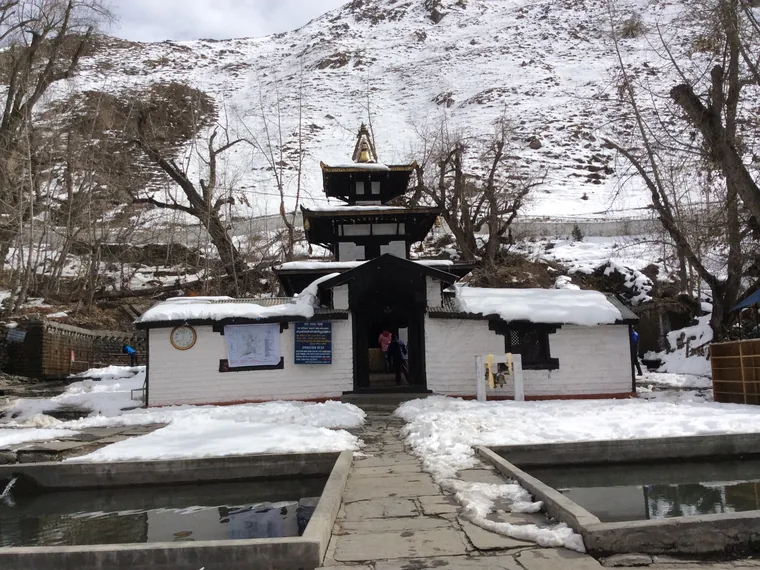
Photo: Sagunkaranjit, CC BY-SA 4.0
Muktinath timings in short
A morning and an afternoon window around a one-hour lunch break, with the afternoon an hour shorter in winter.
History of Muktinath Temple, Mustang
Muktinath is far older as a place of pilgrimage than the building that stands there now. Nepal Tourism Board says the site is mentioned in the Ramayana, the Varaha Purana and the Skanda Purana, and Wikipedia adds the Gandaki Mahatmya of the Vishnu Purana. Its fame grew partly because of the shaligram fossils found along the Kali Gandaki river, stones that Hindus worship as forms of Vishnu.
The Tamil Vaishnava saints knew of it more than a thousand years ago. Wikipedia records that Muktinath is praised in the Nalayira Divya Prabandham, the Vaishnava canon of the 7th to 9th centuries. Thirumangai Alvar never reached the temple but sang ten hymns in its praise from the nearest place he could reach, and Periyalvar called Vishnu here the Lord of Salagram.
The present temple is modest. Nepal Tourism Board describes it as a simple pagoda-style building believed to have been built at the beginning of the 19th century. Beside it stand the 108 water spouts where pilgrims bathe and the Jwala Mai temple, whose flame, Wikipedia explains, is fed by natural gas escaping from the ground.
Access has changed. Nepal Tourism Board describes the old way, a flight to Jomsom and then a five-hour walk, and notes that a newly built road now lets buses run up to Muktinath from the Kali Gandaki valley. Today the temple is managed by the Muktinath Development Committee, chaired by the Chief District Officer of Mustang.
- Altitude
- 3,710 m (committee), 3,800 m (NTB)
- Deity
- Vishnu; Avalokiteshvara to Buddhists
- Divya Desam
- One of the 108 abodes of Vishnu
- Temple built
- Believed early 19th century
- Water spouts
- 108, for a ritual bath
- Nearest town
- Jomsom, 30 to 45 minutes by jeep
Why Muktinath matters to Hindus and Buddhists
For Hindus, Muktinath is Mukti Kshetra, the place of liberation. Its management committee says Hindus believe people can attain moksha here. Wikipedia describes it as one of the 108 Divya Desams of Sri Vaishnavism and one of eight especially sacred self-manifested shrines in that tradition. It is also counted among the 51 Shakta pithas, where, in legend, the head of the goddess Sati fell.
Bathing is at the heart of the pilgrimage. Nepal Tourism Board describes 108 sacred water spouts where pilgrims take a ritual bath, and Wikipedia calls them Mukti Dharas, spouts of liberation. The shaligram stones of the Kali Gandaki add to the site's holiness for Vaishnavas, who worship their different patterns as different forms of Vishnu.
Muktinath is just as important to Buddhists. Tibetan Buddhists call it Chhuming Gyatsa, hundred waters, one of their 24 tantric sites, and they worship the deity as Avalokiteshvara. By tradition, recorded on Wikipedia, Padmasambhava, the founder of Tibetan Buddhism, stayed at Muktinath before going on to Tibet. Nepal Tourism Board notes that Buddhist nuns and Brahmin priests both worship at the temple.
More facts about Muktinath
- Deity
- Vishnu, worshipped by Buddhists as Avalokiteshvara
- Names
- Mukti Kshetra to Hindus, Chhuming Gyatsa ("hundred waters") to Tibetan Buddhists
- Where
- Varagung Muktichhetra Rural Municipality, Mustang, Nepal
- Altitude
- 3,710 m according to the committee; 3,800 m according to Nepal Tourism Board
- Status
- One of the 108 Divya Desams of Sri Vaishnavism
- Temple
- A pagoda-style temple believed to date from the beginning of the 19th century
- Water spouts
- 108 sacred waterspouts where pilgrims take a ritual bath
- Nearby
- Jwala Mai temple, with an eternal flame, sacred to both Hindus and Buddhists
- Managed by
- Muktinath Development Committee, chaired by the Chief District Officer of Mustang
- Also known as
- Muktinath Mandir, Mukti Kshetra, Chumig Gyatsa, Chhuming Gyatsa, Muktinath Temple Nepal
Entry rules at Muktinath
The temple's committee publishes no entry fee, dress code or photography rule. The official rules that do apply are about the area, not the temple.
Temple entry
No entry fee, dress code or entry restriction is published by the Muktinath Development Committee.
Annapurna Conservation Area fee
Nepal Tourism Board lists NRs. 100 for Nepali, NRs. 1,000 for SAARC nationals and NRs. 3,000 for other foreigners, per person per entry, free below 10 years.
Where the fee is paid
At the Tourist Service Center, Bhrikutimandap, Kathmandu, or at the entry points.
Upper Mustang restricted area
A special permit of USD 50 per person per day applies to ward 3 and Satang village of ward 5 of Baragung Muktichhetra Rural Municipality, among other areas of Upper Mustang.
Horse and stretcher services
Local youths from four villages of ward 1 carry pilgrims to the temple on horseback or by stretcher.
How to reach Muktinath Temple
By air
The committee lists flights from Kathmandu to Pokhara (about 25 minutes) and Pokhara to Jomsom (about 20 minutes). Direct Kathmandu to Jomsom flights take about 1 hour 15 minutes but are less frequent. From Jomsom a local jeep takes 30 to 45 minutes.
By road
By road, the committee lists a tourist bus from Kathmandu to Pokhara of about 6 to 7 hours, then a jeep or bus to Jomsom of about 5 to 8 hours (7 to 8 hours on its route from Pokhara), then a local jeep of 30 to 45 minutes to Muktinath.
By road
From Lumbini or Chitwan, the committee says to travel to Pokhara first, about 4 to 5 hours, and continue from there.
By road
Trekkers reach Muktinath on the Annapurna Circuit, which crosses the Thorong La pass at 5,380 m before descending to the temple.
Best time to visit Muktinath
The committee's own timetable points to the warmer half of the year. In its summer period, 15 March to 15 October, the temple is open 7:00 AM to noon and 1:00 PM to 6:00 PM. In winter, 16 October to 14 March, the afternoon ends an hour earlier, at 5:00 PM. Nothing is published about closures for snow. At 3,710 metres by the committee's figure, the altitude matters in every season.
Plan the day around the lunch break. The temple is closed from noon to 1:00 PM every day, and the jeep from Jomsom takes 30 to 45 minutes, so leaving Jomsom early lets you finish darshan and the bath under the 108 spouts before midday.
The committee lists Shivaratri, Janai Purnima and Sorashraddha, the day before Ghatasthapana, as the temple's annual festivals. For 2025 it gave Shivaratri as 26 February and Janai Purnima as 9 August.
Tips before you go
- Check the committee's website, muktinathdc.org.np, for a newer timetable. The dated periods it published ended on 14 March 2026.
- Arrive before noon or after 1:00 PM. The lunch break is listed every day.
- In winter, aim to finish by 5:00 PM, when the afternoon opening ended in the committee's 2025 to 2026 timetable.
- Foreign visitors should budget for the Annapurna Conservation Area fee: NRs 3,000 for most foreigners and NRs 1,000 for SAARC nationals.
- If walking up is hard, local youths from four villages of ward 1 carry pilgrims to the temple on horseback or by stretcher.
- For questions before you travel, the committee's information officer can be reached on +977 9857040777.
A temple above 3,700 metres, and the road from Pokhara
At Muktinath the journey and the altitude shape the visit far more than the opening hours do.
Reaching Muktinath
The committee sets out two main routes from Kathmandu. By road, a tourist bus to Pokhara of about 6 to 7 hours, a jeep or bus to Jomsom of about 5 to 8 hours, then a local jeep of 30 to 45 minutes to Muktinath. By air, flights to Pokhara and on to Jomsom of about 25 and 20 minutes, then the same jeep.
It adds that direct flights from Kathmandu to Jomsom take about 1 hour 15 minutes but are less frequent. Nepal Tourism Board notes that Muktinath lies on the Annapurna Circuit trek, which crosses the Thorong La pass at 5,380 m before descending to Muktinath.
Altitude
The committee gives the temple's altitude as 3,710 metres; Nepal Tourism Board gives 3,800 metres. Either way it is high enough for altitude sickness, and the committee keeps a dedicated page and repeated notices about it.
Pilgrims who fly into Jomsom and drive straight up gain height very quickly. This site does not give medical advice, but the committee's warnings are worth reading before booking a same-day return.
Not verified yet 6 items no official source publishes
- Opening hours for the year from 15 March 2026. The committee's dated timetable ended on 14 March 2026 and no newer one had been posted.
- Aarti times. The committee's home page and its timing page give different times for both seasons.
- Any dress code, and whether bathing under the 108 spouts has rules on clothing. Nothing is published.
- Photography rules inside the temple.
- Whether the temple site itself lies inside the Annapurna Conservation Area fee zone, and whether road arrivals are checked for the permit. Nepal Tourism Board lists the fee but not the checkpoints.
- The ward the temple is in. The committee's contact details say ward 1 and its temple page says ward 5, which matters because NTB's restricted-area permit covers Satang village of ward 5.
Know one of these from an official notice? Send it to us and the page is updated with a new date.
Questions about visiting
Answered from what the temple publishes, with the gaps left as gaps.
What are the Muktinath Temple timings?
The Muktinath Development Committee publishes 7:00 AM to 12:00 noon and 1:00 PM to 6:00 PM, with a lunch break from 12:00 to 1:00 PM. In its 2025–26 winter period the afternoon closed at 5:00 PM.
Who runs Muktinath Temple?
The Muktinath Development Committee, chaired by the Chief District Officer of Mustang. Every timing on this page comes from the committee's own website.
Is there an entry fee for the temple?
The committee publishes none. Nepal Tourism Board does list an Annapurna Conservation Area fee of NRs. 3,000 for foreigners, NRs. 1,000 for SAARC nationals and NRs. 100 for Nepali citizens, but that is for the protected area, not the temple.
Do Indian pilgrims need a permit?
Indian citizens are SAARC nationals, for whom NTB lists an Annapurna Conservation Area fee of NRs. 1,000. Whether it is checked for pilgrims driving to the temple has not been verified here.
Is there a dress code?
None is published by the committee, and this site does not import one from travel pages.
How high is Muktinath?
The committee gives 3,710 metres and Nepal Tourism Board gives 3,800 metres. Both are well into the range where altitude sickness occurs, and the committee publishes repeated warnings about it.
How do I get to Muktinath?
The committee describes reaching Jomsom by road from Pokhara, about 7 to 8 hours, or by a 20-minute flight, then a local jeep of 30 to 45 minutes to Muktinath.
What are the 108 water spouts?
Nepal Tourism Board describes 108 sacred waterspouts near the temple where pilgrims take a ritual bath. The committee states the belief that bathing there removes sin.
Why is Muktinath sacred to Buddhists as well?
Buddhists worship the deity as Avalokiteshvara, and Tibetan Buddhists call the site Chhuming Gyatsa, one of their 24 tantric sites. Buddhist nuns and Brahmin priests both worship at the temple.
Is Muktinath open all year?
The committee's timing page lists the morning opening for all 365 days of its timing year, with a shorter afternoon in winter. Closures for snow are not published.
Can I get carried to the temple?
The committee says local youths from four villages of ward 1 carry pilgrims to the temple on horseback or by stretcher. Prices are not published.
Is Muktinath one of the Divya Desams?
Yes. It is counted among the 108 Divya Desams of Sri Vaishnavism, which is why many South Indian pilgrims make the journey.
Need the timings in full?
The timings page carries the whole published schedule, block by block, and what to check before you travel.