
Pashupatinath Temple, Kathmandu
The largest Shiva temple in Nepal, on the banks of the Bagmati in Kathmandu, a UNESCO World Heritage Site since 1979. The Pashupati Area Development Trust, which runs the temple, publishes it as open daily from 4 AM to 9 PM, with the evening aarti from 5 PM. Before any of that matters, one rule decides the visit: the trust states that the main sanctum is for Hindus only, and non-Hindu visitors watch from the surrounding ghats.
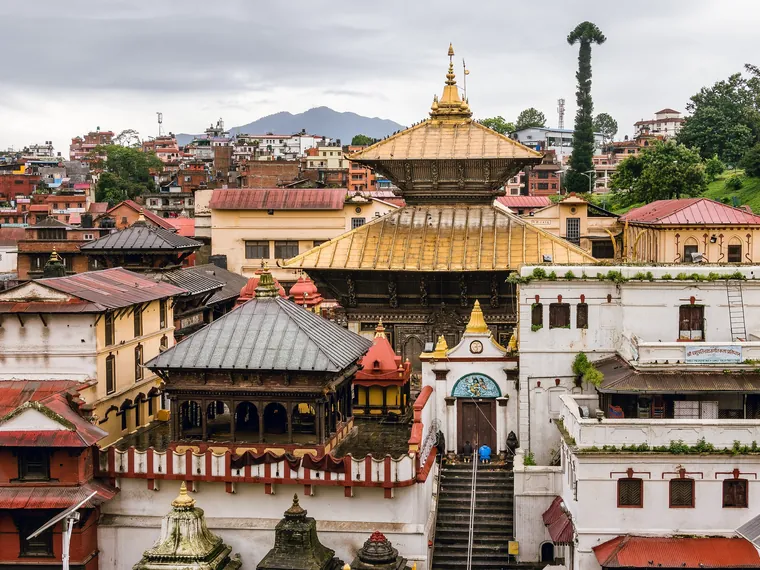
Photo: Bijay Chaurasia, CC BY-SA 4.0
Pashupatinath timings in short
One published window from 4 AM to 9 PM every day, with puja in the morning and two aartis in the evening.
History of Pashupatinath Temple, Kathmandu
Pashupatinath is the oldest Hindu temple in Kathmandu, and its beginnings are older than any record. Wikipedia notes that tradition treats it as pre-Vedic, and that the temple's existence is recorded as early as 400 CE. Chronicles disagree about who built it. The Gopal Raj Vamshavali credits Prachanda Deva, a Licchavi king. Another account says a linga-shaped shrine stood here before the Licchavi king Supushpa Deva built a five-storey temple, and the Pashupati Area Development Trust (PADT), which runs the site, also names Supushpa Deva as its builder.
The temple has been rebuilt many times. Wikipedia records a reconstruction under King Shivadeva (1099 to 1126) and a renovation by Ananta Malla, who added a roof. Other temples grew up around it over the centuries, including a Vaishnava complex with a 14th-century Rama temple and the Guhyeshwari temple, which is mentioned in an 11th-century manuscript. The present temple dates from the late 17th century, after termites and earthquakes damaged the earlier building. Wikipedia gives the year as 1692; PADT says it was built in 1697 by King Bhupalendra Malla of Kantipur.
The main temple is in the Newar pagoda style, with a two-tiered copper roof covered in gold, a gold pinnacle and four main doors covered in silver sheets. PADT describes its gilded roofs and doors and the carved wooden and metal struts as its most striking features. The inner sanctum holds a stone mukhalinga about one metre high, with faces in the four directions.
In 1979 the temple precinct was inscribed as a UNESCO World Heritage Site, one of the seven monument groups of the Kathmandu Valley. In 1987 King Birendra set up PADT to conserve and manage the temple and its surroundings. PADT describes the Pashupati Area as covering 264 hectares, full of temples, shrines, Buddhist viharas, stupas, ashrams and inscriptions, and calls it an open museum. Wikipedia gives the area as 246 hectares.
- First recorded
- As early as 400 CE
- Present temple
- 1692 (Wikipedia) or 1697 (PADT)
- Architecture
- Pagoda style, gold-covered copper roofs
- UNESCO
- World Heritage Site since 1979
- Pashupati Area
- 264 hectares, according to PADT
- Managed by
- Pashupati Area Development Trust, 1987
Why Pashupatinath matters to Hindus
Pashupati, lord of all creatures, is a name of Shiva that PADT says has been known since the Vedic period. PADT explains it as a compound of pashu, animal, and pati, lord. In Hindu thought a person without wisdom is like a pashu, bound by ignorance, and by surrendering to Pashupatinath the devotee seeks liberation. PADT describes Pashupatinath as having five faces, Tatpurusha, Aghora, Sadyojata, Vamadeva and Ishana, and says every Hindu hopes to make the pilgrimage here at least once in a lifetime.
Legend links the temple with the Kedarnath story. In the Shiva Purana, as Wikipedia summarises it, Shiva hid from the Pandavas underground in the form of a bull and reappeared in pieces: his head at Pashupatinath, his hump at Kedarnath, and other parts at Rudranath, Tungnath and Madhyamaheshwar. PADT puts it the same way, calling Pashupatinath the head of Kedareshwor. The Nepal Tourism Board also records a legend of Shiva taking the form of a deer, which is why deer are kept in the Sleshmantak forest around the temple.
The site is sacred beyond Hinduism too. Wikipedia notes that Buddhists link the complex with mahasiddhas such as Matsyendranath, Gorakhnath and Padmasambhava. It is also a place of last rites. Cremations are held every day on the ghats along the Bagmati, and PADT, which runs Arya Ghat and Bhasmeshwar Ghat, publishes daily figures for them on its website.
More facts about Pashupatinath
- Deity
- Shiva, as Pashupati
- Where
- On the banks of the Bagmati river, Kathmandu, Nepal
- UNESCO
- Inscribed as a World Heritage Site in 1979, one of seven monument groups in the Kathmandu Valley designation
- Size
- The complex occupies 246 hectares
- Shrines
- 518 mini-temples alongside the principal pagoda-style temple
- Main festival
- Maha Shivaratri
- Also known as
- Pashupatinath, Pashupati Temple, Pashupatinath Mandir
Entry rules at Pashupatinath
The access rule at Pashupatinath is the reason most visits go differently than expected, and it is not something a ticket resolves.
Main sanctum
Hindus only. The trust states that non-Hindu visitors are not permitted inside the main sanctum.
Everyone else
Observation from the surrounding ghats is permitted, and the ghats are open to all.
Entrance fee
A foreigner needs to pay an entrance fee of 1,000 Nepalese rupees, about ten US dollars, to enter the site.
Suggested visit length
About 90 to 120 minutes.
How to reach Pashupatinath Temple
By air
Tribhuvan International Airport, Kathmandu, is about 1 km from Pashupatinath Temple.
By road
The temple is about 5 km east of the city centre. Taxis, microbuses and three-wheeled tempos drop visitors at Gaushala, a short walk from the temple.
By road
PADT lists bus routes 11, 22 and 30 to Gaushala, and says a taxi from Thamel takes about 15 minutes.
Best time to visit Pashupatinath
Pashupatinath is open every day of the year. PADT gives the temple hours as 4:00 AM to 9:00 PM and publishes its daily schedule on its website: morning puja from 4:00 AM, the Mahabhishek from 7:00 AM to noon, and evening and night aarti after 5:00 PM. Early morning and the evening aarti are the times to come for the rituals.
For a quieter visit, avoid the big festival days. PADT calls Maha Shivaratri, in the month of Falgun (February to March), the most sacred festival here, when hundreds of thousands of pilgrims and sadhus from Nepal and India worship through the night. Teej, in Bhadra (August to September), fills the temple with women in red saris. The Nepal Tourism Board adds that the temple is just as crowded every Ekadashi, the eleventh day of each lunar fortnight, and above all on Harishayani Ekadashi in Ashadh (June to July) and Haribodhini Ekadashi in Kartik (October to November).
If you want to see the temple at its most intense, those same festivals are the days to come. Dashain, in Ashwin or Kartik (September to October), brings special Mahabhishek pujas, according to PADT. Expect huge crowds and special darshan routes, which PADT announced in notices before Teej and the Mondays of Shrawan in 2026.
Tips before you go
- Non-Hindus cannot enter the main temple. They can watch from the terraces across the Bagmati to the east, and PADT says the ghats are open to all.
- Leave leather items, including shoes and belts, outside the temple complex.
- Do not take photographs inside the main sanctum. PADT says the outer areas and ghats may be photographed respectfully.
- Cremations take place on the ghats every day, so be discreet around them.
- Before a festival, check the notices on pashupati.gov.np, where PADT posts darshan routes and special arrangements.
- PADT publishes puja rates on its website. A Panchamrit puja at Pashupatinath is listed at NRs 2,100.
Not verified yet 6 items no official source publishes
- The aarti and ritual schedule. No timetable is published on the source this page reads.
- Whether the entrance fee applies to visitors who cannot enter the courtyard, and what it covers.
- How courtyard eligibility is checked at the gate, and what is asked for.
- Whether the published hours change on Maha Shivaratri, when attendance is very high.
- Dress code, footwear rules and whether cameras are permitted.
- Whether prasad is distributed, where, and to whom.
Know one of these from an official notice? Send it to us and the page is updated with a new date.
Questions about visiting
Answered from what the temple publishes, with the gaps left as gaps.
Can non-Hindus enter Pashupatinath Temple?
Not the main sanctum. The Pashupati Area Development Trust states that it is for Hindus only, and that non-Hindu visitors may watch from the surrounding ghats, which are open to all.
What are the Pashupatinath timings?
The Pashupati Area Development Trust publishes the temple as open daily from 4 AM to 9 PM, with morning puja from 4 AM, the Mahabhishek until noon, evening aarti from 5 PM and night aarti from 7 PM. Its temple page adds that the main temple gates close at 2 PM and reopen for the evening aarti.
Is there an entrance fee?
A foreigner needs to pay an entrance fee of 1,000 Nepalese rupees, about ten US dollars, to enter the site. Whether that fee applies to visitors who cannot enter the courtyard has not been verified here.
When is the best time to visit?
Early in the morning, during the morning puja and Mahabhishek, or for the evening aarti from 5 PM. The afternoon is the part the trust describes differently on its own pages. About ninety minutes to two hours is the suggested length for a visit.
What can I see if I cannot enter the courtyard?
The complex from the opposite bank of the Bagmati, along with the wider site, which occupies 246 hectares and holds 518 mini-temples besides the principal pagoda. It is a different visit rather than a lesser one.
What are the aarti times?
On the trust's day schedule, evening aarti runs from 5 to 7 PM and night aarti from 7 to 8 PM. The trust's temple page gives the evening aarti as 6 PM in winter and 7 PM in other seasons.
Is there a dress code?
Not published on the source this page reads. Dress modestly as you would at any temple in the region, and expect footwear rules at the very least.
How large is the complex?
246 hectares, holding 518 mini-temples alongside the principal pagoda-style temple. It is a site to walk around rather than a single building to visit.
What is its UNESCO status?
It was inscribed as a World Heritage Site in 1979 and is one of seven monument groups within the Kathmandu Valley designation.
What is the main festival?
Maha Shivaratri, which draws a very large crowd. Whether the published hours change on that date has not been verified here.
How do I check before travelling?
Settle the courtyard question first, because no timing matters if you cannot go in. Then confirm the hours and the fee close to your date, since neither is published with a revision date.
Can I take photographs?
Not verified. No photography rule is published on the source this page reads. Cremations take place at the ghats here, so discretion matters regardless of what any rule permits.
Need the timings in full?
The timings page carries the whole published schedule, block by block, and what to check before you travel.