
Kedarnath Temple, Uttarakhand
The Jyotirlinga of Shiva in the Garhwal Himalaya, at 3,584 metres on the Mandakini, run by the Shri Badarinath Kedarnath Temple Committee. It is open for only part of the year: for 2026 the doors opened on 22 April at 8:00 AM, and the committee had not announced the winter closing date when this page was checked. Two rules decide a visit. Registration with the Government of Uttarakhand is compulsory before you set out, and mobile phones are banned inside the temple premises.
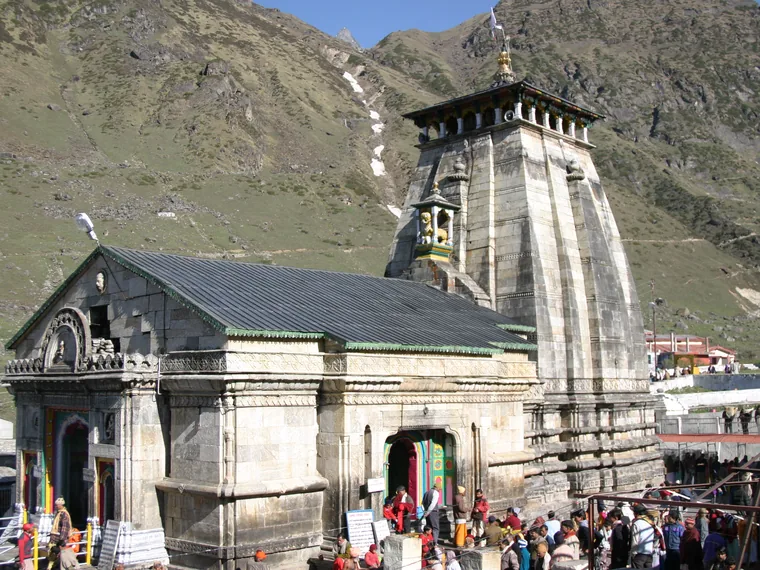
Photo: Shaq774 at en.wikipedia, Public domain
Kedarnath timings in short
A seasonal shrine with a published opening date, an unannounced closing date, and no published daily darshan hours. The queue at the temple runs on tokens rather than on a clock.
History of Kedarnath Temple
Nobody knows for certain who first built Kedarnath Temple or when. Wikipedia notes that the original builder and date are uncertain. The Shri Badarinath Kedarnath Temple Committee (BKTC) says the present temple was originally built in the 8th century AD by Adi Shankaracharya, next to an earlier structure linked with the Pandavas. The Government of Uttarakhand's pilgrim portal describes it the same way: tradition credits the Pandavas with the first temple, and Adi Shankaracharya revived it in the 8th century CE.
Written references go back a long way. Wikipedia cites a story in the Skanda Purana naming Kedara as the place where Shiva released the waters of the Ganges from his matted hair. By the 12th century Kedarnath appears in the Kritya-kalpataru, written by Bhatta Lakshmidhara, a minister of the Gahadavala kings. Adi Shankaracharya's link with the place runs deep: some accounts of his life say he died in the mountains near Kedarnath, and his samadhi shrine stands behind the temple.
BKTC describes a temple built of very large, heavy, evenly cut grey stone slabs on a rectangular platform, with inscriptions on the grey steps, carved figures and mythological scenes on the inner walls, and a Nandi statue guarding the entrance. The sanctum holds the conical rock worshipped as Shiva.
The temple's recent history is marked by the flash floods of 16 and 17 June 2013. According to Wikipedia, a huge boulder lodged behind the temple and turned the debris aside, so the building survived while the complex and the area around it were destroyed and hundreds of pilgrims and local people died. The boulder is now worshipped as Bhim Shila. Teams from the Archaeological Survey of India and IIT Madras later found the structure stable.
- Altitude
- 3,584 metres
- Deity
- Shiva, one of the 12 Jyotirlingas
- Revived by
- Adi Shankaracharya, 8th century
- Trek
- About 16 km from Gaurikund
- Open
- Roughly April to November
- Winter seat
- Omkareshwar Temple, Ukhimath
Why Kedarnath matters to Hindus
Kedarnath is one of the twelve Jyotirlingas, the most sacred shrines of Shiva, and BKTC and Wikipedia both describe it as the highest of them. It is also one of the four shrines of Uttarakhand's Char Dham Yatra, and the first of the Panch Kedar, the five Shiva temples of Garhwal: Kedarnath, Tungnath, Rudranath, Madhyamaheshwar and Kalpeshwar. Wikipedia adds that it is one of the 275 Paadal Petra Sthalams praised in the Tamil Tevaram hymns.
The best known story is a legend from the Mahabharata tradition. After the Kurukshetra war, the Pandavas went looking for Shiva to atone for killing their kin. Shiva kept avoiding them and hid at Kedarnath in the form of a bull (BKTC says a buffalo). When Bhima caught hold of it, the animal sank into the ground, and in the legend its hump stayed at Kedarnath while other parts of the body appeared at the other Panch Kedar shrines. BKTC says the conical rock in the sanctum is worshipped as Shiva in his Sadashiva form.
The deity's yearly journey is part of the temple's importance. When the doors close for winter, BKTC says a symbolic statue of Shiva is carried down to the Omkareshwar Temple at Ukhimath and worshipped there until the temple reopens in spring.
More facts about Kedarnath
- Deity
- Shiva, worshipped in his Sadashiva form as a conical rock formation
- Status
- One of the twelve Jyotirlingas of Shiva, and part of the Char Dham and the Panch Kedar
- Where
- On the bank of the Mandakini river, Rudraprayag district, Garhwal, Uttarakhand
- Altitude
- 3,584 metres above sea level
- The trek
- About 16 km from Gaurikund, the nearest road head
- Administered by
- Shri Badarinath Kedarnath Temple Committee, constituted under a 1939 Act
- Winter seat
- Omkareshwar Temple, Ukhimath
- Season
- Open to the public only between April and November because of extreme weather
- Also known as
- Kedarnath Dham, Shri Kedarnath, Kedarnath Jyotirlinga, Kedareshwar, Kedarnath Mandir
Entry rules at Kedarnath
Registration, a darshan token and the phone ban are the three rules most likely to change a visit. Each is published by the state government or the temple committee.
Registration
As per the Government of Uttarakhand travel policy, pilgrims must register themselves and their vehicles before starting the journey to the Char Dham. Registration is free.
How to register
Online through the state portal or the Tourist Care Uttarakhand app, which generates a Yatra Registration Letter with a QR code. Physical registration points include Sonprayag for Kedarnath.
Verification
Pilgrims must verify themselves at each shrine on arrival, and keep the registration certificate ready at the verification point.
Darshan token
Collect a Dham darshan slot token. The portal lists a queue token slot counter at Kedarnath Temple.
BKTC notice
The temple committee's own site tells pilgrims to ensure their yatra registration on registrationandtouristcare.uk.gov.in.
Mobile phones
Carrying mobile phones inside the temple premises, taking photographs or videos, and making social media reels are prohibited. Violations may face legal action.
Helicopter
Helicopter shuttle tickets for Kedarnath can be booked only on heliyatra.irctc.co.in.
Puja booking
Prior registration on the BKTC site is mandatory for puja, path, aarti and bhog bookings, and it must use an Indian mobile number.
ID for pujas
A valid government photo ID must be carried with an attending puja receipt. Foreign pilgrims use a valid passport and visa.
Refunds
Puja bookings are non-refundable and cannot be moved to another name or date. BKTC reserves the right to reschedule them.
Kedarnath dress code
Neither BKTC nor the state portal publishes a dress code for Kedarnath on the pages read here. The state portal does publish what to bring, and at 3,584 metres the clothing advice is not optional.
- Carry warm clothing: jacket, shawl, gloves and the like.
- Carry prescribed medicines, if any.
- Carry valid personal ID proof.
- Do not consume alcohol or tobacco.
How to reach Kedarnath Temple
By air
BKTC names Jolly Grant Airport near Dehradun, which has daily flights from Delhi, as the nearest airport, with taxis on to Gaurikund. For the last stretch, the state portal lists helicopter services from Guptkashi, Sirsi and Phata. BKTC says tickets are sold only on heliyatra.irctc.co.in.
By train
The nearest railway stations are Rishikesh, Haridwar and Dehradun. BKTC names Rishikesh as the nearest, with road transport from there to Gaurikund.
By road
The road ends at Gaurikund. The state portal gives about 250 km from Dehradun and about 220 to 240 km from Haridwar or Rishikesh, which takes 9 to 10 hours. After that comes a 16 km trek that takes 6 to 8 hours on foot. Ponies and palkis can be hired.
Best time to visit Kedarnath
Kedarnath can only be visited while the temple is open, which is roughly April or May to October or November. BKTC says the shrine usually opens in Vaishakh (April to May) and closes on the first day of Kartik (October to November). In winter, snowfall of up to several metres is common and temperatures drop below zero. BKTC calls May to November the best months overall.
Within the season, BKTC describes May and June as very pleasant and moderately cold, which makes them the easiest months for the trek. From July to mid-September the monsoon brings regular rain and landslides, which makes the roads and the path risky. After the rains, the weeks before the doors close in autumn are another option, but nights at 3,584 metres are cold. Whenever you go, register first and pack warm clothes, as the state portal advises.
Tips before you go
- Register for the Char Dham Yatra before you set out. It is free, and you must verify yourself when you reach the shrine.
- Collect a darshan slot token at the Dham. The portal lists a queue token counter at the temple.
- Leave your phone behind: mobile phones, photos, videos and reels are banned inside the temple premises.
- Book helicopter shuttle tickets only on heliyatra.irctc.co.in, the one source BKTC names.
- Allow 6 to 8 hours for the 16 km walk up from Gaurikund.
- Carry warm clothes, a valid photo ID and any medicines you take, and do not bring alcohol or tobacco.
How the doors open, and how you reach them
Kedarnath's calendar and its approach are both unusual. The deity moves with the seasons, and the last stretch is on foot or by air.
The opening of the doors
The 2026 opening date was announced on Maha Shivaratri, 15 February, after Panchang calculations at the Omkareshwar Temple in Ukhimath. The Panchmukhi Doli of Kedarnath left Ukhimath on 19 April, reached Gaurikund on 20 April and arrived at Kedarnath Dham on 21 April, and the doors opened with traditional rituals at 8 AM on 22 April.
BKTC describes the reverse journey at the onset of winter: on an auspicious date it announces in advance, the symbolic statue of Shiva is carried down to Ukhimath and worshipped there until the temple reopens in the spring.
Reaching the temple
The road ends at Gaurikund. BKTC and the state portal both describe a trek of about 16 km from there to the temple, and the portal estimates six to eight hours on foot. From Dehradun it gives about 250 km by road to Gaurikund via Rishikesh, Rudraprayag, Guptkashi and Sonprayag.
The state portal lists helicopter services from Guptkashi, Sirsi and Phata. BKTC names Rishikesh as the nearest railway station and Jolly Grant as the nearest airport, and suggests Sitapur, Sonprayag and Guptkashi as places to stay for a single-day visit by helicopter or pony.
Not verified yet 8 items no official source publishes
- Daily darshan opening and closing times for 2026. The state portal says they will be announced soon, and BKTC publishes none.
- The 2026 closing date. BKTC traditionally announces it in the autumn and had not published it when this page was checked.
- A restriction on entry for non-Hindus to Kedarnath and other BKTC temples, reported in the press in March 2026 as a committee resolution. It has not been found on the BKTC site or a government page here.
- Hours and location of the darshan slot token counter, and how far ahead tokens run.
- Where phones are deposited, and whether lockers are free. Press reports mention a locker facility near the temple, not verified on an official page.
- Any dress code for the sanctum.
- Helicopter fares and schedules, which are sold only through IRCTC.
- BKTC's Kedarnath page also states the temple stays closed in the monsoon months, which contradicts the yatra running through the monsoon. That line is not relied on here.
Know one of these from an official notice? Send it to us and the page is updated with a new date.
Questions about visiting
Answered from what the temple publishes, with the gaps left as gaps.
When did Kedarnath open in 2026?
The doors opened at 8:00 AM on 22 April 2026. The date was announced on Maha Shivaratri at the Omkareshwar Temple in Ukhimath, the winter seat, and the state registration portal lists the same date.
When does Kedarnath close for winter in 2026?
Not verified here. The Badarinath Kedarnath Temple Committee had not published the 2026 closing date when this page was checked on 17 September 2026. Its own page says the shrine generally closes around the start of Kartik.
What are the Kedarnath darshan timings?
No official daily timetable has been published for 2026. The Government of Uttarakhand portal says the opening and closing time and the aarti and bhog time will be announced soon. BKTC publishes the evening aarti as starting around 6 PM in summer.
Is registration compulsory for Kedarnath?
Yes. The Government of Uttarakhand states that pilgrims must register themselves and their vehicles before starting the Char Dham journey, and verify themselves at each shrine. The temple committee's site points pilgrims to the same portal.
How do I register?
Free, on registrationandtouristcare.uk.gov.in or the Tourist Care Uttarakhand app, which gives a Yatra Registration Letter with a QR code. The portal also lists physical registration points, including Sonprayag for Kedarnath.
Do I need a token for darshan?
The state portal tells pilgrims to collect a Dham darshan slot token and lists a queue token slot counter at Kedarnath Temple. Counter hours have not been verified here.
Can I take my phone into Kedarnath Temple?
No. A BKTC member announced in April 2026 that carrying mobile phones inside the temple premises, taking photos or videos and making reels are prohibited, and that violations may face legal action.
Is there a dress code at Kedarnath?
None is published by BKTC or the state portal on the pages read here. The portal does tell pilgrims to carry warm clothing such as a jacket, shawl and gloves, along with ID and any prescribed medicines.
How do I book a helicopter?
BKTC states that helicopter shuttle tickets for Kedarnath can be booked only on heliyatra.irctc.co.in. The state portal lists services from Guptkashi, Sirsi and Phata.
How long is the trek?
About 16 km from Gaurikund, where the road ends. The state portal estimates six to eight hours on foot.
Can I book a puja?
Yes, through the BKTC site after registering with an Indian mobile number. Attending pujas need the receipt and a government photo ID, and bookings are non-refundable.
Can non-Hindus visit Kedarnath?
Not verified here. The press reported in March 2026 that BKTC passed a resolution restricting entry for non-Hindus to its temples, including Kedarnath. This site has not found it published on the BKTC site or a government page, so check with BKTC before travelling.
Need the timings in full?
The timings page carries the whole published schedule, block by block, and what to check before you travel.