
Kashi Vishwanath Temple, Varanasi
One of the twelve Jyotirlinga shrines, in Vishwanath Gali in Varanasi, managed since 1983 by a board of trustees set up by the Government of Uttar Pradesh. The temple's own rituals page states it opens daily at 2:30 A.M. and closes at 11 PM, with five aartis through the day and darshan in the gaps between them. The temple publishes that schedule on two different pages, and they do not entirely agree, which is set out below rather than smoothed over.
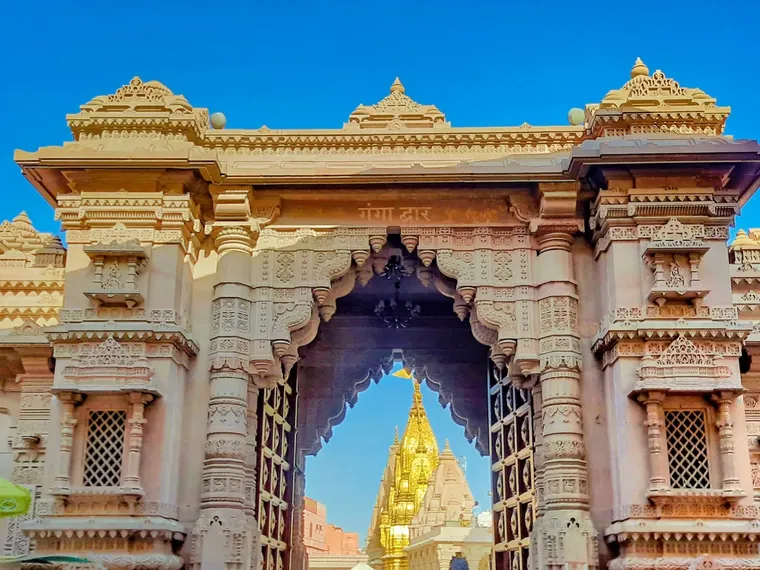
Photo: Ashvin Kaitabhya, clicked by Abhishek Pandey, CC BY-SA 4.0
Kashi Vishwanath timings in short
A twenty and a half hour day bracketed by two aartis, with darshan filling the space between the ceremonies rather than running as one uninterrupted block.
History of Kashi Vishwanath Temple
The original shrine, known as the Adi Vishveshwar Temple, was destroyed by the Ghurids in 1194, and the Razia Mosque was built on its site between 1236 and 1240. A new temple went up near the Avimukteshwara Temple by the end of the 13th century, but it was damaged under the Sharqi rulers of Jaunpur and demolished under Sikandar Lodi in 1490.
Raja Man Singh began rebuilding during Akbar's reign and Raja Todar Mal carried the work forward in 1585. In 1669 the Mughal emperor Aurangzeb had that temple destroyed and the Gyanvapi Mosque built in its place; remains of the older temple can still be seen in the mosque's foundation, columns and rear wall.
The present temple was built beside the mosque in 1780 by Ahilyabai Holkar, the Maratha ruler of Indore. In 1835 Maharaja Ranjit Singh of the Sikh Empire gave 1 tonne of gold to plate its dome, which is why the temple is popularly called the Golden Temple. Management passed to a board of trustees set up by the Government of Uttar Pradesh in 1983.
The Kashi Vishwanath Dham Corridor, linking the temple to the Ganges, was inaugurated on 13 December 2021. Around 1,400 residents and businesses were relocated for it, and more than 40 old temples were found and rebuilt within its area. In February 2022 the sanctum was gold-plated with 60 kg of gold from an anonymous donor.
- Deity
- Shiva as Vishwanath, a Jyotirlinga
- Present temple
- 1780, built by Ahilyabai Holkar
- Gold plating
- 1 tonne from Ranjit Singh, 1835
- Linga
- 60 cm tall, on a silver altar
- Corridor opened
- 13 December 2021
- Pilgrims a day
- About 45,000 on average in 2023
Why Kashi Vishwanath matters to Hindus
Kashi Vishwanath is one of the twelve Jyotirlinga shrines of Shiva, and its deity is known as Vishwanath or Vishweshwara, Lord of the Universe. By legend, this is where Shiva appeared as an endless column of light before Brahma and Vishnu when they argued over which of them was supreme. Neither could find the column's end. Brahma falsely claimed he had, and Shiva cursed him for the lie.
Varanasi is regarded as among the holiest Hindu cities, and a visit to the temple with a bath in the Ganges is one of the practices believed to lead towards moksha, or liberation. Many Hindus therefore hope to make the pilgrimage at least once. Hindu scriptures describe Vishweshwara as king over the other deities of the city and the Panchkoshi circuit around it. By tradition, pilgrims give up at least one desire after the visit, and the pilgrimage is linked with Rameswaram in Tamil Nadu, where devotees take Ganges water.
More facts about Kashi Vishwanath
- Deity
- Vishwanath, also Vishweshwara, meaning Lord of the Universe
- Status
- One of the twelve Jyotirlinga shrines
- Where
- Vishwanath Gali, Varanasi, Uttar Pradesh
- Administered by
- A board of trustees set up by the Government of Uttar Pradesh, since 1983
- Spire
- A 15.5 metre high spire on the temple
- Corridor
- The Kashi Vishwanath Dham Corridor was inaugurated on 13 December 2021 and connects the temple to the Ganges
- Footfall
- An average of 45,000 pilgrims per day in 2023
- Since the corridor
- The temple trust reported 10 crore visitors between December 2021 and August 2023
- Also known as
- Kashi Vishwanath, Vishwanath Temple, Kashi Vishwanath Dham, Shri Kashi Vishwanath Temple
Kashi Vishwanath dress code
Quoted from the temple trust's own FAQ, because the wording is the rule.
- There is no dress code for Darshan, however the devotees are advised to wear decent clothes.
- Any electronic or non-electronic gadgets, pen etc. is not allowed inside the temple premises.
- Free lockers are available on Mandir Chauk, YSK-1, YSK-2, YSK-3 and Helpdesk.
How to reach Kashi Vishwanath Temple
By air
Lal Bahadur Shastri International Airport is at Babatpur, 26 km (16 mi) north-west of Varanasi.
By train
Varanasi Junction is the main railway station serving Varanasi. Banaras, Varanasi City, Kashi and Pandit Deen Dayal Upadhyaya Junction also serve the Varanasi area.
By road
The temple trust names Chaudhary Charan Singh Bus Stand as the nearest bus station. From the river, entry from Ganga Ghat through Gate No. 1 into the corridor is allowed from 06:00 to 21:00.
Best time to visit Kashi Vishwanath
Varanasi has a humid subtropical climate. The dry summer runs from April to June, with temperatures that can reach 46 °C, and the monsoon follows from July to October. Winter brings warm days and cold nights: cold waves from December to February can push temperatures below 5 °C, and fog is common. That makes winter days the gentlest time for walking the lanes and ghats, provided you are ready for a cold pre-dawn queue.
Festival days bring the heaviest crowds. The temple trust lists Rangbhari Ekadashi, Diwali, monthly Shivratri, Mahashivratri and the month of Kartik among its major occasions. Rangbhari Ekadashi, twelve days after Mahashivratri, marks Shiva's return to Kashi with Parvati.
Within the day, darshan runs in the gaps between the aartis. The trust's FAQ gives 04:00 to 11:00, 12:20 to 19:00 and 20:30 to 21:00, and the early morning block after Mangala Aarti is the longest of them.
Tips before you go
- Leave phones, other gadgets and even pens behind or in a locker: the trust bars all of them from the premises.
- Free lockers are available at Mandir Chauk, YSK-1, YSK-2, YSK-3 and the Helpdesk.
- For Mangala Aarti, report at 02:30 and use Gate No. 1. Other aartis can be entered from any gate.
- Aarti bookings cannot be cancelled, and the trust treats the booking amount as a donation, so it is not refunded.
- Entry is free. Sugam Darshan, which skips the queue with a Shastri escort, costs Rs. 300 per person.
- The Helpdesk is near Gate No. 4 of the temple.
Not verified yet 5 items no official source publishes
- Whether bags are permitted. The trust's FAQ bars gadgets and pens and lists free lockers, but says nothing specific about bags.
- What Mangala Aarti tickets cost, how many are issued and how they are bought.
- Which of the temple's two published schedules is the current one where the two disagree.
- Whether the Rs. 300 Sugam Darshan price in the trust's FAQ is still current. The FAQ is undated.
- Whether darshan runs continuously between the aartis or pauses within those blocks.
Know one of these from an official notice? Send it to us and the page is updated with a new date.
Questions about visiting
Answered from what the temple publishes, with the gaps left as gaps.
What time does Kashi Vishwanath Temple open and close?
The temple's own rituals page states it opens daily at 2:30 A.M. and closes at 11 PM. Shayan Aarti runs from 10:30 PM to 11:00 PM, so the closing time follows immediately from the last ceremony.
What are the five aartis?
Mangala Aarti at 3:00 to 4:00 AM, Bhog Aarti at 11:15 AM to 12:20 PM, Sandhya Aarti at 7:00 to 8:15 PM, Shringar Aarti at 9:00 to 10:15 PM and Shayan Aarti at 10:30 to 11:00 PM, as published on the temple's aarti page.
Why do two official pages give different times?
Because the temple publishes the schedule in two places and they have drifted. The rituals page gives Bhog Aarti as 11:30 AM to 12 PM and calls the evening aarti Sapta Rishi Aarti at 7 to 8:30 PM. Both are shown here rather than one being picked.
When can I actually get darshan?
The rituals page lists general darshan from 4 to 11 AM, again from 12 PM to 7 PM, and briefly from 8:30 to 9 PM. Those are the gaps between the ceremonies rather than a single continuous window.
Do I need a ticket for Mangala Aarti?
The temple's rituals page notes that ticket holders are permitted at Mangala Aarti. What the ticket costs, how many are issued and how it is bought have not been verified here.
What is the dress code?
The temple trust's FAQ says there is no dress code for darshan, but devotees are advised to wear decent clothes.
Can I take my phone inside?
No. The temple trust's FAQ states that any electronic or non-electronic gadgets, pens included, are not allowed inside the temple premises. It lists free lockers at Mandir Chauk, YSK-1, YSK-2, YSK-3 and the Helpdesk.
What is Sugam Darshan?
Paid darshan without the queue. The temple trust's FAQ prices it at Rs. 300 per person: a Shastri takes the devotee near the sanctum, and a box of prasad and a locker are included free. Entry to the temple itself is free.
How has the corridor changed the visit?
The Kashi Vishwanath Dham Corridor was inaugurated on 13 December 2021 and connects the temple to the Ganges. Guides written before that date describe an approach through the old lanes that no longer matches the route.
How busy is it?
An average of 45,000 pilgrims a day in 2023, and the temple trust reported 10 crore visitors in total between the corridor's inauguration in December 2021 and August 2023.
Who runs the temple?
A board of trustees set up by the Government of Uttar Pradesh has managed it since 1983. Every timing on this page comes from that board's own site.
Can I rely on these timings?
Treat them as the shape of the day and confirm on the temple's own site before travelling. The two published pages differ on two of the five aartis, which tells you how much precision the source itself supports.
Need the timings in full?
The timings page carries the whole published schedule, block by block, and what to check before you travel.