
Meenakshi Amman Temple, Madurai
The temple of Meenakshi and Sundareswarar in the middle of Madurai, administered by the Hindu Religious and Charitable Endowments Department of the Tamil Nadu government. Its administrator publishes opening from 5:00 AM to 12:30 PM and again from 4:00 PM to 10:00 PM. The three and a half hour afternoon closure is the single most useful fact on this page, because midday is when most visitors have time and the temple does not.
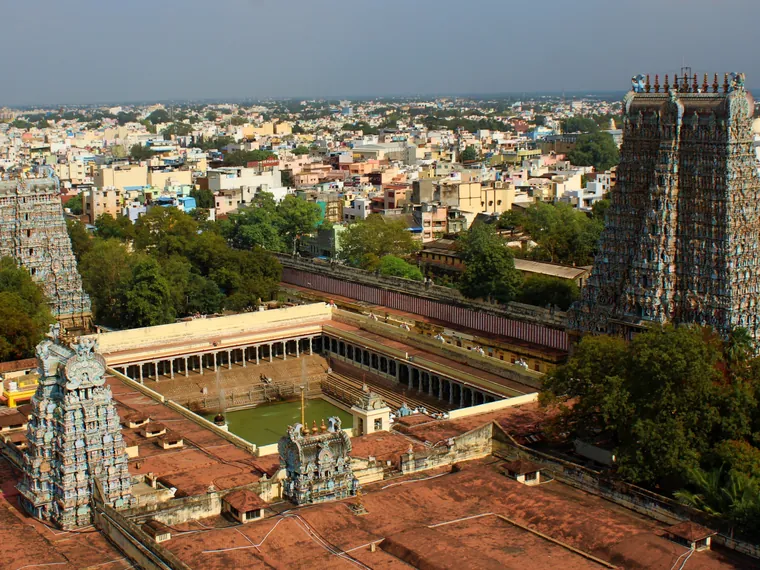
Photo: Prakashkumar, CC BY-SA 4.0
Meenakshi Amman timings in short
Two windows with a long afternoon closure between them, published by the state department that administers the temple.
History of Meenakshi Amman Temple
Madurai appears in Tamil Sangam literature of the 1st to 4th centuries CE, and Tamil texts suggest a temple stood in the city by the mid-6th century. The oldest surviving masonry dates from the Pandya emperor Sadayavarman Kulasekaran I (r. 1190 to 1216), who built the gopuram at the entrance to the Sundareswarar shrine and the central part of the Meenakshi shrine. His successors added more towers in the 13th century, including the Chitra gopuram on the west.
In 1311 Malik Kafur, leading the armies of the Delhi Sultanate, raided Madurai, destroyed temples including this one and carried a vast haul of gold and jewellery back to Delhi. The temple stayed closed for about 60 years. After the Vijayanagara Empire took Madurai in 1378, Kumara Kampana rebuilt the temple and its defensive walls, and the idols that had been hidden were brought back and reconsecrated.
Most of what visitors see today was built or expanded by the Madurai Nayaks in the 16th and 17th centuries. Under Vishwanatha Nayak (r. 1529 to 1564) the complex was fortified and the vimana over the Meenakshi shrine was gilded, and his minister Ariyanatha Mudaliar oversaw the thousand-pillared hall. The tallest tower, the southern gopuram, was built in the late 16th century, and Tirumala Nayaka (r. 1623 to 1655) added the Vasantha mandapa.
The temple declined during British rule and was restored after independence with money collected from the public. On 8 July 1939 a group of Dalits led by A. Vaidyanatha Iyer and Kakkan entered the temple, one of the events that led the Madras Presidency to end the exclusion of the depressed classes later that year. The temple is administered by Tamil Nadu's Hindu Religious and Charitable Endowments Department, and kumbhabhishekam ceremonies were held in 1974, 1995 and 2009.
- Deities
- Meenakshi and Sundareswarar
- Complex
- 5.7 ha (14 acres)
- Gopurams
- 14; the tallest is 52 m (170 ft)
- Thousand-pillared hall
- 985 carved pillars
- Temple tank
- Golden lotus pond, 50 m by 37 m
- Administered by
- Tamil Nadu HR&CE Department
Why Meenakshi Amman Temple matters to Hindus
The temple is dedicated to Meenakshi, a form of Parvati, and her consort Sundareswarar, a form of Shiva. Her name means fish-eyed. In the 16th-century Thiruvilaiyadal Puranam, a daughter appeared from the sacrificial fire of King Malayadhwaja Pandya, grew up to rule Madurai, and took her true form as Meenakshi when she met Shiva, whom she married. For most devotees Meenakshi is the more important of the pair: her shrine sits at the centre of the complex and is visited first, and she is addressed as Mother.
The temple brings together three strands of Hinduism. Shiva is Meenakshi's husband, Vishnu is her brother who gives her away at the wedding, and Meenakshi herself is central to the Shakta tradition. It is a Paadal Petra Sthalam, one of the 276 Shiva temples praised in the Tevaram hymns, and the Thiruvilaiyadal Puranam names it among the four most important of 68 Shaiva pilgrimage places, with Varanasi, Chidambaram and Tirukkalatti. The Sundareswarar shrine is counted as the Velli Ambalam, the silver hall, one of the five courts where Shiva performed his cosmic dance.
More facts about Meenakshi Amman
- Deities
- Meenakshi, a form of Parvati, and Sundareswarar, a form of Shiva
- Where
- Madurai, Tamil Nadu
- Administered by
- Hindu Religious and Charitable Endowments Department, Government of Tamil Nadu
- Gopurams
- Fourteen in total: four nine-storey, one seven-storey, five five-storey and two three-storey
- Tallest tower
- The southern gopuram, at 170 ft (52 m), built in the late sixteenth century
- Main festival
- Meenakshi Tirukalyanam, celebrated over 15 days in the month of Chithirai
- Nightly ritual
- Metallic footprints representing Shiva are carried in a palanquin to Meenakshi's chamber every evening
- Also known as
- Meenakshi Temple, Madurai Meenakshi Temple, Meenakshi Sundareswarar Temple, Meenakshi Amman Kovil
How to reach Meenakshi Amman Temple
By air
Madurai International Airport is about 12 km (7.5 mi) south of the city centre, with domestic flights and a few international routes.
By train
Madurai Junction, in the Southern Railway's Madurai division, serves the city and connects towards Dindigul, Virudhunagar, Manamadurai and Bodinayakanur.
By road
Madurai has three major bus stands: the Mattuthavani Integrated Bus Terminus, Arappalayam and Periyar. The temple sits at the centre of the old city, where the streets run in concentric rings around it.
Best time to visit Meenakshi Amman Temple
Madurai is hot and dry for eight months of the year, and March to July are the hottest months, with summer highs of around 42 °C. The climate is more moderate from August to October, with heavy rain and thunderstorms, and slightly cooler from November to February, when winter temperatures range from about 18 °C to 30 °C. That cooler stretch is the gentlest time for walking the temple's open courtyards and streets.
The biggest crowds come with Chithirai Thiruvizha in the Tamil month of Chithirai, when the Meenakshi Tirukalyanam, the divine wedding, is the most attended festival of the year. The administrator states that the timings of daily poojas change during festival time. Navaratri in Purattasi is another busy period, when the complex is lit up at night and golu displays fill the golu mandapa.
Within the day, the published hours are 05:00 to 12:30 and 16:00 to 22:00, with the temple kept closed in between, so plan a morning or evening visit rather than one around midday.
Tips before you go
- Do not plan to arrive between 12:30 and 16:00: the administrator states the temple is kept closed then.
- Check the administrator's page before travelling; it has carried a notice closing temple services for the Kumbhabishegam ceremony.
- Visit the Meenakshi shrine before Sundareswarar, as most pilgrims do, since she is the temple's primary deity.
- Look for the musical pillars outside the thousand-pillared hall, which give a note when struck.
- The thousand-pillared hall houses an art museum with icons, photographs and drawings about the temple.
Not verified yet 6 items no official source publishes
- Individual pooja and abhishekam times. The administrator publishes the opening windows only.
- The dress code. Nothing is published on the administrator's page, and this site will not import a rule the temple has not stated.
- Whether phones, cameras and bags are permitted inside, and where they are deposited.
- Ticket prices for any special darshan queue.
- Whether the Kumbhabishegam closure noted on the administrator's page is current.
- How much the timings actually shift during the Chithirai festival.
Know one of these from an official notice? Send it to us and the page is updated with a new date.
Questions about visiting
Answered from what the temple publishes, with the gaps left as gaps.
What are the Meenakshi Amman Temple timings?
Its administrator publishes 5:00 AM to 12:30 PM and 4:00 PM to 10:00 PM. The three and a half hours between those windows are a stated closure, not a quiet period.
Is the temple closed in the afternoon?
Yes, and explicitly so. The administrator states that from 12.30 P.M. to 4.00 P.M. the temple will be kept closed, and that it opens again at 4.00 PM for darshan.
Who administers the temple?
The Hindu Religious and Charitable Endowments Department of the Government of Tamil Nadu. The timings on this page come from that department's own site rather than from a travel page.
Are pooja times published?
No. The administrator publishes the two opening windows and nothing more granular, so this page does not print a pooja schedule. Any site showing one is using a source this page has not verified.
Do the timings change during festivals?
The administrator states that during festival time the timings of the daily poojas are changeable. It does not say by how much, and this site has not verified festival schedules.
What is the dress code?
Not published by the administrator. That is not the same as there being none. Dress modestly as you would at any large South Indian temple, and expect footwear to be removed.
Can I take my phone or camera inside?
Not verified. The administrator publishes no rule on phones, cameras or bags, so expect a restriction and check at the entrance rather than assuming either way.
How many gopurams does the temple have?
Fourteen: four nine-storey, one seven-storey, five five-storey and two three-storey. The tallest is the southern gopuram at 170 feet, about 52 metres, built in the late sixteenth century.
What is the temple's main festival?
Meenakshi Tirukalyanam, the divine wedding, celebrated over fifteen days in the Tamil month of Chithirai. It is the most attended festival of the temple's year.
What is the nightly ceremony?
Metallic footprints representing Shiva are carried in a palanquin to Meenakshi's chamber every evening, and morning rituals wake the divine couple. It is a fixed part of the temple's day rather than an occasional event.
Is the temple ever closed for ceremonies?
The administrator's page has carried a notice that services were temporarily closed in view of the Kumbhabishegam ceremony. Whether that notice is current has not been verified, which makes checking before travelling worthwhile.
Can I rely on these timings?
They are the administrator's own published hours, which is the best source that exists. They are also only three lines long, so for anything more precise than open or closed, telephone the temple before a long journey.
Need the timings in full?
The timings page carries the whole published schedule, block by block, and what to check before you travel.