
Shree Siddhivinayak Temple, Prabhadevi
The temple of Ganesh as Siddhivinayak at Prabhadevi in Mumbai, run by the Shree Siddhivinayak Ganapati Temple Trust. The Trust publishes two different days: from Wednesday to Monday darshan runs from 6:00 AM to 9:50 PM in blocks, while on Tuesday it starts at 3:15 AM and runs to 11:30 PM. Chaturthi days have schedules of their own. The Trust also asks visitors to switch off phones, dress decently and leave footwear outside.
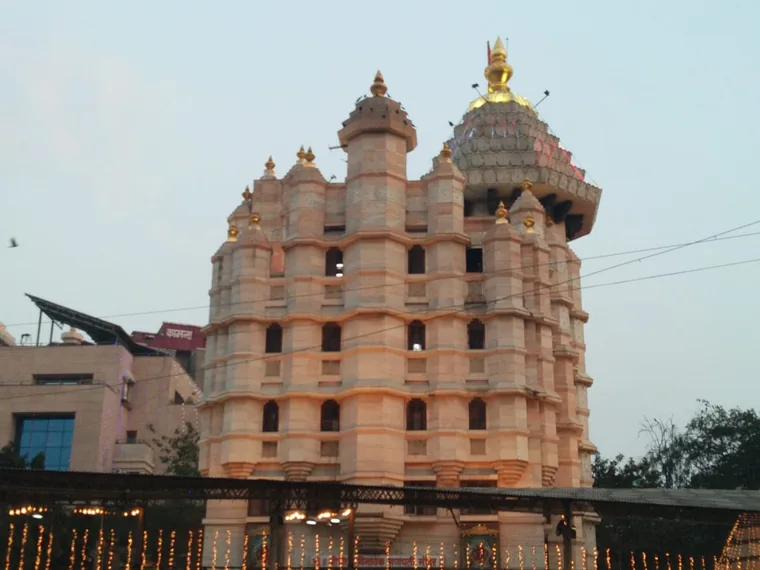
Photo: Feroze Ahmad 2, CC BY-SA 4.0
Siddhivinayak timings in short
Two published days rather than one. Tuesday starts nearly three hours earlier and ends nearly two hours later than the rest of the week, and has a long evening break of its own.
History of Siddhivinayak Temple, Mumbai
The Shree Siddhivinayak Ganapati Temple Trust records that the temple at Prabhadevi was first consecrated on Thursday 19 November 1801, a date it says is noted in government records. Wikipedia and Maharashtra Tourism credit Laxman Vithu and Deubai Patil with building it. The first temple was a small structure housing the black stone idol that is still worshipped today.
The Trust describes that old temple as a hall and a sanctum, some open space, an administrative office to the right and a water tank in front. For an idea of what it looked like, it points visitors to the Kashi Vishveshwar temple near the Matunga signal, close to Citylight Cinema.
Siddhivinayak history turned a corner in 1990, when the Trust began rebuilding the temple around the idol without touching it. The architect, Sharad Athale of SK Athale and Associates, surveyed temples in Rajasthan and Tamil Nadu but chose the stone Shiva temple at Ambernath as the model, because it had stood up to a hot, humid climate, a monsoon of nearly four months and the nearness of the sea. The work took three years, cost three crore rupees and used mainly marble and pink granite. The old Kalash was lowered with the proper rites and is kept on display inside the premises.
The rebuilding ended with the Kalash Pratishthapana and Kumbhabhishek on Monday 13 June 1994, Jyeshtha Shuddha Chaturthi, performed by the Shankaracharya of Sringeri, Bharati Tirtha Mahaswami. The temple has been governed since 1980 by the Shri Siddhi Vinayak Ganapati Temple Trust (Prabhadevi) Act, adopted on 11 October that year.
- First consecrated
- 19 November 1801
- Idol
- Black stone, trunk turned to the right
- Present temple
- Rebuilt 1990 to 1993, consecrated 1994
- Building
- Six storeys, gold-plated central dome
- Main Kalash
- 12 feet high, about 1,500 kg, gold plated
- Tuesday crowd
- Up to about 2 lakh devotees
Why Siddhivinayak matters to devotees
Ganesh is worshipped first before any new venture, as Vighnaharta, the remover of obstacles, and the Trust calls Siddhivinayak the temple that fulfils the desires of its worshippers. Maharashtra Tourism gives the name the same meaning, the one who grants wishes, and says devotees come from all over India to ask for success, prosperity and the removal of obstacles.
The idol itself is a large part of the pull. The Trust describes a four-armed Ganesh in black stone holding a lotus, a small axe, holy beads and a bowl of modaks, with an eye on the forehead like the third eye of Shiva, and Riddhi and Siddhi on either side. Its trunk turns to the right, which the Trust calls unique, since a Ganesh trunk usually curves to the left. By the Trust's own figures, Tuesdays and Angarak Sankashti Chaturthi, when Sankashti falls on a Tuesday, bring the largest crowds, up to about 2 lakh people.
Devotees who cannot reach the idol in the rush often take darshan of the gold-plated main dome instead. The Trust compares this to the way pilgrims at Pandharpur bow to the crown of the Vitthal temple on Ashadhi and Kartiki Ekadashi when they cannot get inside.
More facts about Siddhivinayak
- Deity
- Ganesh, as Siddhivinayak, flanked by Riddhi and Siddhi
- The idol
- Black stone, carved from a single stone, 2.5 feet high and 2 feet wide, with the trunk turned to the right
- First consecrated
- Thursday 19 November 1801
- Built by
- Laxman Vithu and Deubai Patil
- Where
- S.K. Bole Marg, Prabhadevi, Mumbai 400028, Maharashtra
- Administered by
- Shree Siddhivinayak Ganapati Temple Trust, regulated by the Shri Siddhi Vinayak Ganapati Temple Trust (Prabhadevi) Act, 1980
- Present building
- Renovation began in 1990 and took three years; crown installation and Kumbhabhishek on 13 June 1994
- Structure
- Six-storey multi-angular building with a gold-plated central dome
- Also known as
- Siddhivinayak Mandir, Shree Siddhivinayak Ganapati Mandir, Siddhivinayak Temple Mumbai, Prabhadevi Ganpati temple
Entry rules at Siddhivinayak
What the Trust itself publishes about entering and about the special days. Tuesday and Chaturthi arrangements are where most visits go wrong.
Mobile phones
The Trust asks devotees to switch off their mobile phones before entering the temple.
Footwear
Removed and left at the stands outside the temple entrance.
Tuesday checkpost
Both temple checkpost main doors close for devotees at 11:30 PM on Tuesday.
Vinayaki Chaturthi
Devotees are not permitted in the main temple from 7:30 AM to 1:00 PM while the Maha Abhishek is performed, and flowers and fruits are not allowed during that time.
Mezzanine floor
On Tuesdays the mezzanine floor is opened after 1:00 PM, once poojas and abhishek are over.
Booked poojas
Booked at the Pooja Booking Counter daily between 7:00 AM and 7:00 PM, and performed only under the direction of the temple priests.
Online booking
The Trust's notice states that online booking of the Ashirvachan pooja is open, and that its mobile app is being updated.
Siddhivinayak dress code
The Trust runs a standing notice to devotees on its website, in Marathi. These are its three requests, translated plainly.
- Devotees should wear clothing in keeping with the culture when entering the temple.
- Indecent, uncivil or revealing clothing should not be worn into the temple.
- Footwear should be removed and left at the stands outside the temple entrance.
How to reach Siddhivinayak Temple
By air
Fly into Chhatrapati Shivaji Maharaj International Airport, Mumbai. The Aqua Line of the Mumbai Metro has stations at the airport and runs south to Siddhivinayak station, so the whole trip can be made underground without changing lines.
By train
By metro: Siddhivinayak station on Mumbai Metro Line 3, the Aqua Line, opened on 10 May 2025 on S.K. Bole Road, the temple's own street. Exits A1, A2, A3 and A4 are listed for Shree Siddhivinayak Mandir.
By train
By suburban train: the nearest stations are Prabhadevi (formerly Elphinstone Road) on the Western line and Parel on the Central line.
By road
The temple is on S.K. Bole Marg in Prabhadevi, between Dadar to the north and Worli to the south. BEST buses run through Prabhadevi, and the Bandra-Worli Sea Link connects the area to Bandra and the western suburbs.
Best time to visit Siddhivinayak Temple
The day of the week matters more than the season. Tuesday is the busiest day: the Trust estimates 1.5 to 2 lakh people use the common darshan area around the Gabhara every Tuesday, and on Angarak Sankashti Chaturthi common darshan runs from 2:00 AM until about 1:00 AM the next morning. If a quiet darshan is the aim, go on any day from Wednesday to Monday and avoid the Chaturthi dates the Trust lists on its important dates page.
On ordinary days darshan starts at 6:00 AM, straight after Kakad Aarti, and runs in long blocks to 7:00 PM with only a short break for Naivedhya from 12:05 PM to 12:30 PM. The evening is broken up by Dhup Aarti at 7:00 PM and the evening aarti from 7:30 PM, so the morning and afternoon blocks give the most time in the queue without interruption. On Vinayaki Chaturthi avoid the morning altogether, because devotees are kept out of the main temple from 7:30 AM to 1:00 PM.
Mumbai has a heavy monsoon of nearly four months, which is why the temple was rebuilt in stone to the Ambernath model. The Trust publishes no change to the schedule for the monsoon, but travel across the city is simpler outside the rains. Ganesh Chaturthi in Bhadrapad and Maghi Ganesh Jayanti are the great festivals of the year, with their own schedules, and are best for devotees who want the celebrations rather than a short darshan.
Tips before you go
- Check the day of the week before you go: the Trust runs a separate, much longer schedule on Tuesday.
- Check the Trust's important dates page for Sankashti and Vinayaki Chaturthi, which change the day's timings.
- Leave flowers and fruit behind on Vinayaki Chaturthi mornings; they are not allowed during the Maha Abhishek.
- Switch off your phone before entering, as the Trust asks.
- Wear modest clothing and leave footwear at the stands outside the entrance.
- If the queue to the Gabhara is too long, the common darshan platform and the mezzanine gallery also give a view of the idol.
The days that change the clock
Most visitors know Tuesday is busy. Fewer know that the Trust publishes whole separate schedules for it and for each kind of Chaturthi.
Tuesday, and Angarak Sankashti
Tuesday is the day the Trust opens earliest and closes latest, with darshan from 3:15 AM and Shejaarti at 11:45 PM. The Trust estimates that 1.5 to 2 lakh people use the common darshan area around the Gabhara every Tuesday.
When Sankashti Chaturthi falls on a Tuesday it is Angarak Sankashti Chaturthi. The Trust says common darshan then begins at 2:00 AM on Tuesday and runs to about 1:00 AM on Wednesday. The next Angarak Sankashti on its 2026 list is Tuesday 29 September, with moonrise at 9:05 PM.
Vinayaki and Sankashti Chaturthi
On Vinayaki Chaturthi the morning is given over to the Maha Abhishek: darshan runs 6:00 AM to 7:30 AM, devotees are kept out of the main temple from 7:30 AM to 1:00 PM, and darshan resumes at 1:00 PM on the usual schedule. The Trust lists Vinayak Chaturthi on 14 October, 13 November and 13 December 2026.
On Sankashti Chaturthi darshan opens at 4:30 AM and the evening is timed to the moon. The doors close for pooja, abhishek and naivedhya 90 minutes before moonrise, the aarti follows moonrise, and Shejaarti comes about 15 to 20 minutes after that aarti.
Ganesh Jayanti and Ganesh Chaturthi
On Maghi Shree Ganesh Jayanti and on Bhadrapad Shree Ganesh Chaturthi darshan opens at 4:00 AM, and the temple doors stay closed from 10:45 AM to 1:30 PM for pooja, naivedhya and aarti, with darshan possible only from a distance. On Ganesh Chaturthi the Trust lists Shejaarti at 10:00 PM; on Ganesh Jayanti it follows the end of the chariot procession.
Not verified yet 6 items no official source publishes
- Whether there is a separate paid or priority darshan queue, and what it costs. The Trust's app offers appointment booking, but its terms have not been verified here.
- Cloak room or phone deposit arrangements. The Trust asks for phones to be switched off, but whether they may be carried in, and where bags go, is not published on the pages read.
- Security screening rules and a list of items not allowed through the checkpost.
- Current pooja fees. The Trust's site carries two versions of its pooja table with slightly different details, so the amounts are not reproduced here.
- Wheelchair access and any assisted route for elderly visitors.
- Whether the Trust publishes any change to the standing schedule during Bhadrapad Ganeshotsav beyond Ganesh Chaturthi itself.
Know one of these from an official notice? Send it to us and the page is updated with a new date.
Questions about visiting
Answered from what the temple publishes, with the gaps left as gaps.
What are the Siddhivinayak Temple timings?
From Wednesday to Monday the Trust publishes darshan from 6:00 AM to 9:50 PM, in blocks between aartis. On Tuesday darshan starts at 3:15 AM and the checkpost doors close at 11:30 PM. Chaturthi days have separate schedules.
Why is Tuesday different?
Tuesday is the temple's busiest day, and the Trust publishes a separate schedule for it. It opens nearly three hours earlier than other days and closes much later, and the Trust estimates 1.5 to 2 lakh people use the common darshan area every Tuesday.
Is the temple open every day?
Yes. The Trust publishes one schedule for Wednesday to Monday and another for Tuesday, which covers the whole week. It lists no weekly closed day.
Can I take my phone into Siddhivinayak?
The Trust's notice asks devotees to switch off their mobile phones before entering the temple. It does not, on the pages read here, say phones must be deposited, and cloak room arrangements have not been verified.
What is the dress code at Siddhivinayak?
The Trust asks devotees to dress in keeping with the culture and not to enter in indecent, uncivil or revealing clothing. It does not publish a list of specific garments.
Where do I leave my footwear?
The Trust asks devotees to remove footwear and leave it at the stands outside the temple entrance. Whether a charge applies has not been verified here.
What happens on Angarak Sankashti Chaturthi?
When Sankashti Chaturthi falls on a Tuesday, the Trust says common darshan begins at 2:00 AM and runs until about 1:00 AM the next morning. The next one on the Trust's 2026 list is Tuesday 29 September.
Can I book a pooja?
Yes. The Trust's Pooja Booking Counter is open daily from 7:00 AM to 7:00 PM, and online booking of the Ashirvachan pooja is open on the Trust's site. Current fees are not reproduced here.
Who built the temple?
It was first consecrated on 19 November 1801, and Wikipedia credits Laxman Vithu and Deubai Patil with building it. The present six-storey building dates from a renovation begun in 1990, with its crown installed in June 1994.
What is special about the idol?
The Trust describes a black stone idol carved from a single stone, 2.5 feet high and 2 feet wide, with the trunk turned to the right rather than the usual left, and Riddhi and Siddhi on either side.
Who runs Siddhivinayak Temple?
The Shree Siddhivinayak Ganapati Temple Trust, regulated by a state Act of 1980. Every timing and rule on this page comes from the Trust's own site.
Can I watch darshan online?
The Trust runs a live darshan page on its website and a WhatsApp channel for daily darshan and aarti. Its notice says the temple app is being updated.
Need the timings in full?
The timings page carries the whole published schedule, block by block, and what to check before you travel.