
Shri Mahakaleshwar Jyotirlinga, Ujjain
The south-facing Jyotirlinga of Shiva in Ujjain, run by the Shri Mahakaleshwar Temple Management Committee and known above all for the Bhasma Aarti from 4:00 AM to 6:00 AM, which the committee says is performed every day at no other Shivalinga in the world. Seats for it are booked online on the committee's own website only, on a fixed release schedule, and every visitor on a booking is registered with an ID proof and a photograph. Madhya Pradesh Tourism states that men must wear a dhoti and women a saree to pray at the inner sanctum, and that phones and cameras are not allowed inside.
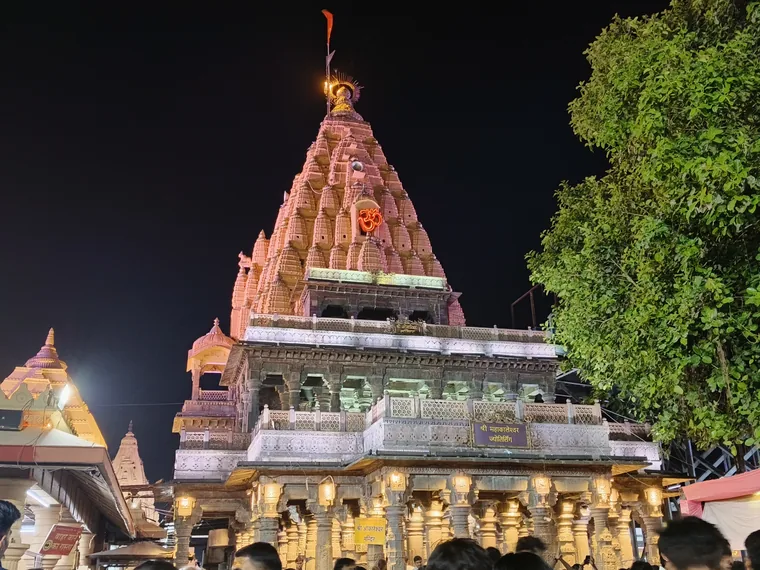
Photo: Ashverse, CC BY-SA 4.0
Mahakaleshwar timings in short
Five aartis from before dawn to near midnight, in two seasonal tables. Bhasma Aarti and Shayan Aarti keep the same times all year; the three in between shift with the season.
History of Mahakaleshwar Temple, Ujjain
Mahakaleshwar is one of the oldest continuously revered Shiva shrines in India. The Sanskrit poet Kalidasa refers to the temple's evening rituals in the Meghaduta, describing the performance of music and dance, the nada-aradhana, that accompanied worship in Ujjain.
The medieval temple complex was destroyed by Iltutmish during his raid on Ujjain in 1234–35. Wikipedia records that the Jyotirlinga was dismantled and is said to have been thrown into a nearby pond, and that later raids followed under Jalaluddin Khalji and Alauddin Khalji.
The temple standing today dates from the Maratha period. Madhya Pradesh Tourism places its construction in the fourth and fifth decades of the eighteenth century, and Wikipedia credits its revival to the Maratha Diwan Ramachandra Sukthankar. Its architecture blends Bhumija, Maratha and Chalukya styles across five levels, one of them underground, where brass lamps light the way to the sanctum.
After independence in 1947, administration passed from the Mahakaleshwar Dev Sthan Trust to the Ujjain municipal corporation, and it now sits under the Ujjain district collectorate. The Shri Mahakal Lok corridor beside the temple, more than 900 metres long with 108 pillars and around 200 statues, is the most recent chapter in the history of Mahakaleshwar Temple.
- Status
- One of the 12 Jyotirlingas
- Faces
- South, the only Jyotirlinga that does
- Present temple
- 18th century, Maratha period
- Architecture
- Bhumija, Maratha and Chalukya styles
- Levels
- Five, one of them underground
- Known for
- Daily Bhasma Aarti, 04:00 to 06:00
Why Mahakaleshwar matters to Hindus
Mahakaleshwar is one of the twelve Jyotirlingas, the shrines where, according to the Shiva Purana, Shiva appeared as an endless column of light. The name joins maha, great, and kaal, time and death, so Mahakal is Shiva as the lord of time. The lingam is held to be swayambhu, self-manifested, and it faces south. Wikipedia and the temple committee both describe it as the only south-facing Jyotirlinga among the twelve, and Madhya Pradesh Tourism notes the Varaha Purana places Ujjain at the navel of the earth.
Legend, as retold by Madhya Pradesh Tourism and Wikipedia, tells of King Chandrasena of Ujjain, a devotee of Shiva. When rival kings and the demon Dushana attacked the city, a boy named Shrikhar and the priest Vridhi prayed for its protection. Shiva appeared as Mahakal, destroyed the attackers and agreed to remain in Ujjain as its guardian, in the form of the lingam worshipped today.
The temple is also counted among the Shakti Peethas: in legend the upper lip of Sati fell here, and the goddess is worshipped as Mahakali. Wikipedia notes one further custom unique to the shrine, that prasad offered to the deity here may be offered again, unlike at other shrines.
More facts about Mahakaleshwar
- Deity
- Shiva, as Mahakaleshwar, in lingam form
- Status
- One of the twelve Jyotirlingas, and the only south-facing one
- Where
- Ujjain, Madhya Pradesh, beside the Shipra river
- Administered by
- Shri Mahakaleshwar Temple Management Committee, Ujjain
- Present temple
- Built in the fourth and fifth decades of the eighteenth century
- Architecture
- A blend of Bhumija, Maratha and Chalukya styles
- Known for
- The Bhasma Aarti, performed every day at dawn
- Free meals
- The committee's Annakshetra, running since 2 August 2004
- Helpdesk
- Temple helpdesk 18002331008
- Also known as
- Mahakal Temple, Mahakaleshwar Temple, Shri Mahakaleshwar Jyotirlinga, Ujjain Mahakal, Mahakal Mandir
Entry rules at Mahakaleshwar
Bhasma Aarti booking is where most visits succeed or fail, and the committee publishes its release times precisely. Each rule below names who published it.
Bhasma Aarti booking
Available online on the official website only.
Regular booking
Opens on the 1st of the previous month at 8:00 AM. For example, June bookings open on 1 May at 8:00 AM.
Tatkal booking
Opens one day before the selected date at 8:00 AM. For example, Tatkal booking for 10 April opens on 9 April at 8:00 AM.
Visitor details
The Bhasmaarti booking form asks for each visitor's name, an ID proof and number, and an uploaded or captured photograph of the face.
Payment window
The committee's booking portal states that payment must be completed within 15 minutes, or the booking is cancelled automatically and must be started again.
Sandhya and Shayan Aarti
Booked online only. Sandhya Aarti booking opens daily at 12:00 PM and Shayan Aarti at 4:00 PM, first come, first served.
Sheeghra Darshan
Booked through the committee's portal as an advance request. A request does not guarantee a booking, no payment is taken to place it, and if approved a payment link is sent by SMS.
Request limit
No more than 3 advance darshan requests can be placed from any one mobile number or Aadhaar.
Pujan and Sheeghra Darshan
General Puja (Rs 100), Shiv Mahimn Path (Rs 200), Rudrabhishek Vaidik Puja (Rs 300), Shiv Mahimn Strot (Rs 500) and Rudrabhishek Rudra Path (Rs 1,000) require a separate Sheeghra Darshan ticket.
Inner sanctum dress
Men should wear a dhoti and women a saree to offer prayers at the inner sanctum.
Phones and cameras
Not allowed inside the temple premises. Deposit them in the locker room.
Mahakaleshwar dress code
The temple committee does not publish a dress code on the pages read here. Madhya Pradesh Tourism, the state's official tourism body, publishes this rule for the Bhasma Aarti and the inner sanctum.
- Follow the dress code if you wish to offer prayers at the inner sanctum: men should wear a dhoti and women need to wear a saree.
- Mobiles and cameras are not allowed inside the temple premises. Gadgets are deposited in the locker room.
- The aarti begins at 4 a.m. and draws a long queue, so MP Tourism recommends arriving an hour or more before it begins.
How to reach Mahakaleshwar Temple, Ujjain
By air
The nearest airport is Devi Ahilya Bai Holkar Airport in Indore, about 55 km from the temple according to Madhya Pradesh Tourism, with taxis and local transport for the onward drive to Ujjain.
By train
Ujjain Junction, a major station with connections across India on the Indore–Dewas and Ratlam–Bhopal lines, is about 2 km from Mahakaleshwar Temple.
By road
Ujjain is linked by National Highway 47 towards Ahmedabad, NH 552G to Indore and State Highway 18 to Bhopal and Dewas, with buses and taxis from across Madhya Pradesh.
Best time to visit Mahakaleshwar Temple
Ujjain's weather does most to decide the best time to visit Mahakaleshwar. Winter, from early November to early March, is cool, dry and sunny, which makes the pre-dawn queue for the 4:00 AM Bhasma Aarti far more bearable. Summer runs from mid-March to late June, with May averaging a daily maximum of about 41°C, and the monsoon from late June to late September brings heavy rain and thunderstorms.
The festival calendar pulls the other way. Maha Shivaratri, marked with nine days of Shiva Navratri, the Mahakal Sawari processions of Shravan and Bhadrapada, and the Simhastha Kumbh Mela held in Ujjain every twelve years draw the largest crowds. Madhya Pradesh Tourism presents these as the most rewarding times for a pilgrim; outside those dates the crowds are smaller.
Within the day, the temple committee's aarti table sets the rhythm. The Bhasma Aarti needs a booking made well ahead, and MP Tourism advises arriving an hour or more before 4:00 AM. Sandhya and Shayan Aarti seats are booked online too, opening at 12:00 and 16:00 on the day.
Tips before you go
- Book the Bhasma Aarti on the committee's own website only; regular slots open at 08:00 on the 1st of the previous month.
- Keep the ID proof used for each visitor on the booking, since the form records an ID and a photograph for everyone.
- Men should wear a dhoti and women a saree to offer prayers at the inner sanctum.
- Leave phones and cameras in the locker room, as they are not allowed inside the temple premises.
- Reach the queue an hour or more before the 4:00 AM Bhasma Aarti.
- If you visit on Nag Panchami, the Nagchandreshwar shrine on the top level is open for its one day of the year.
A south-facing Jyotirlinga, and the aarti it is known for
The committee and the state tourism body both describe what makes this temple's morning different from any other Jyotirlinga's.
What the Bhasma Aarti is
The committee describes Mahakaleshwar as the only Shivalinga where the Bhasma Aarti is performed every day, with the lingam adorned with sacred ash. It states the ash is prepared from cow dung cakes following prescribed rituals and offered by the Mahant of Shri Panchayati Akhada Mahanirvani or an authorised representative.
MP Tourism describes the sequence: an abhishek of the Shivling with curd, honey and sandal paste, cleaning with milk and water, decoration with flowers and bel leaves, and then the lingam veiled with a cloth while the head priest scatters ash over it, followed by the aarti with lamps and bells. It notes the ash was once taken from a funeral pyre and is now prepared from cow dung.
The temple on five levels
The committee states the Mahakal Jyotirlinga is enshrined on the lowest level, with the Omkareshwar Shivalinga above it and Nagchandreshwar at the top, opened to the public only once a year on Nag Panchami. It describes Mahakaleshwar as the only south-facing Jyotirlinga among the twelve.
MP Tourism dates the present temple to the fourth and fifth decades of the eighteenth century, in a blend of Bhumija, Maratha and Chalukya styles, and describes the Shri Mahakal Lok corridor beside it as more than 900 metres long, with 108 pillars and around 200 statues.
Not verified yet 7 items no official source publishes
- A general darshan window published by the temple committee itself. Only MP Tourism's 4 a.m. to 11 p.m. has been found.
- The price of a Bhasma Aarti booking and of Sheeghra Darshan. Neither is shown on the committee's public pages read here.
- Any dress rule published by the committee itself, including whether men must go bare-chested or women must cover their heads during the ash offering. Only MP Tourism's dhoti and saree rule has been verified.
- The reporting time and entry gate for Bhasma Aarti ticket holders.
- Whether visitors without a booking can see the Bhasma Aarti from any part of the temple.
- The Gregorian dates on which the two seasonal aarti tables change over in 2026.
- A notice on the committee's Sandhya and Shayan Aarti booking pages says those bookings are unavailable on 17 September because of a Deepotsav event in Ujjain. The notice gives no year.
Know one of these from an official notice? Send it to us and the page is updated with a new date.
Questions about visiting
Answered from what the temple publishes, with the gaps left as gaps.
What time is the Bhasma Aarti at Mahakaleshwar?
4:00 AM to 6:00 AM. The Shri Mahakaleshwar Temple Management Committee publishes the same time in both its seasonal tables, so it does not change through the year.
How do I book the Bhasma Aarti?
Online, on the committee's official website only, at shrimahakaleshwar.mp.gov.in. The committee states no other channel. Every visitor on the booking is entered with a name, an ID proof and a photograph.
When does Bhasma Aarti booking open?
Regular booking opens at 8:00 AM on the 1st of the previous month, so June bookings open on 1 May. Tatkal booking opens at 8:00 AM one day before the selected date.
What is the dress code for the Bhasma Aarti?
Madhya Pradesh Tourism states that to offer prayers at the inner sanctum men should wear a dhoti and women a saree. The committee itself publishes no dress code on the pages read here, and further rules often repeated online are not verified here.
Can I take my phone into Mahakaleshwar Temple?
MP Tourism states that mobiles and cameras are not allowed inside the temple premises and that devotees deposit gadgets in the locker room.
What does the Bhasma Aarti cost?
Not verified here. The committee's public pages do not show the price, which appears only inside its booking portal. Figures quoted on other sites have not been checked.
What is Sheeghra Darshan?
Sheeghra means quick: it is a separate darshan the committee offers through its online portal. Advance requests carry no guarantee and no upfront payment; if a request is approved, a payment link is sent by SMS. Up to 3 requests can be placed per mobile number or Aadhaar.
Can I book Sandhya or Shayan Aarti?
Yes, online only. Sandhya Aarti booking opens daily at 12:00 PM and Shayan Aarti booking at 4:00 PM, first come, first served.
Which pujas can I book?
The committee lists pujas from General Puja at Rs 100 up to Maha Rudrabhishek and Mahamrityunjay Jaap at Rs 15,000. The five lower-priced pujas, up to Rs 1,000, need a separate Sheeghra Darshan ticket.
Is there free food at the temple?
Yes. The committee runs a free Annakshetra, which it says began operating on 2 August 2004. Its serving hours have not been verified here.
Where is the temple and who runs it?
In Ujjain, Madhya Pradesh, beside the Shipra river. It is run by the Shri Mahakaleshwar Temple Management Committee, whose helpdesk number is 18002331008.
Can I rely on these rules on the day?
The booking release times and aarti tables come from the committee and are specific. Festival days, Shravan Mondays and events in Ujjain change arrangements, so check the committee's site before travelling.
Need the timings in full?
The timings page carries the whole published schedule, block by block, and what to check before you travel.