
Sree Padmanabhaswamy Temple, Thiruvananthapuram
The temple of Vishnu as Anantha Padmanabha, reclining on the serpent Anantha, inside the East Fort of Thiruvananthapuram. It is one of the strictest temples in India to walk into. The temple publishes a dress code that rules out trousers, shirts and short dresses, a list of nineteen things that may not be carried in, including phones and smartwatches, and Kerala Tourism states that entry is restricted to Hindus. Darshan runs in seven short windows rather than one long one.
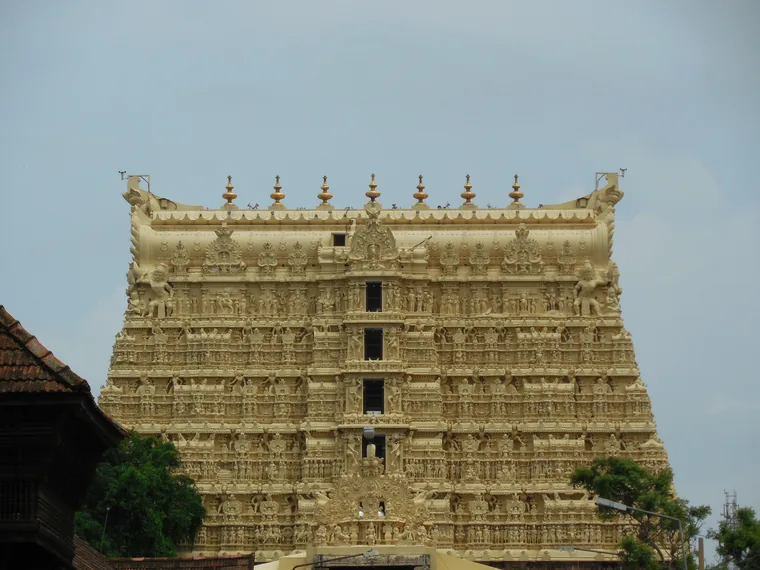
Photo: Aravind Sivaraj, CC BY-SA 3.0
Padmanabhaswamy timings in short
Many short windows instead of one long one. Arriving at a random time is the surest way to wait, because the gaps between windows add up to most of the day.
History of Padmanabhaswamy Temple, Thiruvananthapuram
The temple's own history begins by admitting what is not known: its origin is lost in antiquity, and no reliable record says when or by whom the first idol was consecrated. The temple cites the Bhagavata Purana, which says Balarama visited, bathed in the Padmatheertham and made offerings. It also notes that Nammalwar, the 9th-century Alvar poet-saint, composed ten hymns to Padmanabha, which the temple treats as proof that the shrine existed by then. Wikipedia adds that it is praised in the Divya Prabandham as one of the 13 Divya Desams in the old Malai Nadu region, and that Sangam-era Tamil literature, including the Cilappatikaram, refers to it.
Dated records follow. According to the temple, it was rebuilt and its management reorganised in 1050 AD. Under Veera Marthanda Varma, who ruled Venad from 1335 to 1384, the king took control of its administration, and records show the Alpasi festival being held in 1375. In 1461 the idol was reinstalled with an Ottakkal Mandapam, a single slab of granite, in front of the sanctum. The foundation of the eastern gopuram was laid in 1566. In 1686 a major fire almost completely destroyed the temple, and rebuilding did not start until 1724.
The temple visitors see today is largely the work of Marthanda Varma, who became king of Travancore in 1729. The temple says he replaced the old wooden idol with the present one, made of an amalgam called katusarkarayogam holding 12,008 saligrams. It records that 4,000 sculptors, 6,000 labourers and 100 elephants spent six months building the stone corridor, the Sreebalippura. The gopuram, the gold-covered flagstaff and the steps of the Padmatheertham tank were also finished in his reign. Wikipedia dates the re-consecration to 1731.
On 17 January 1750, Wikipedia records, Marthanda Varma dedicated the kingdom of Travancore to Padmanabhaswamy and declared that he and his heirs would rule as the deity's servants, with the title Sree Padmanabha Dasa. The temple drew worldwide attention in 2011, when some of its vaults were opened on the orders of the Supreme Court. Since 13 July 2020, following the court's ruling, it has been run by an Administrative Committee chaired by the District Judge of Thiruvananthapuram.
- Deity
- Vishnu reclining on the serpent Anantha
- Divya Desam
- One of the 108 abodes of Vishnu
- Idol
- Contains 12,008 saligrams
- Rebuilt
- Under Marthanda Varma, from 1729
- Gopuram
- Foundation laid in 1566
- Where
- East Fort, Thiruvananthapuram
Why Padmanabhaswamy Temple matters to Hindus
Padmanabhaswamy is Vishnu in yogic sleep on the serpent Anantha, with Brahma rising on a lotus from his navel, which is where the name Padmanabha, lotus-navelled, comes from. Wikipedia describes the temple as one of the 108 Divya Desams, the holy abodes of Vishnu in the Sri Vaishnava tradition. Worshippers see the deity through three doors: the head and the Shiva lingam under the right hand through the first, the gold and silver festival images through the second, and the feet through the third.
The temple tells two founding legends. In the one recorded in its palm-leaf records and the Ananthasayana Mahatmya, the sage Divakara Muni is visited by Vishnu as a child who runs away after being scolded. The sage follows him to Ananthankaadu, where the child vanishes into a tree that falls and becomes the huge reclining form of Vishnu. The other, which the temple calls generally accepted, tells the same story of the sage Vilvamangalathu Swamiyar. In both, the sage offers an unripe mango in a coconut shell. The temple says salted mango is still a major offering and the original shell is now covered in gold.
Padmanabhaswamy is also the family deity of the Travancore royal family, whose rulers governed as the god's servants from 1750. Wikipedia records that the head of the family still walks with the Arattu procession at the two main festivals, when the festival idols are taken to Shankumugham Beach for a ritual bath in the sea.
More facts about Padmanabhaswamy
- Deity
- Padmanabhaswamy, a form of Vishnu in yogic sleep on the serpent Shesha
- Idol
- Made up of 12,008 saligrams from the bed of the Gandaki river in Nepal
- Status
- One of the 108 Divya Desams of Vaishnavism
- Where
- East Fort, Thiruvananthapuram, Kerala
- Gopuram
- Seven storeys, about 35 metres, on the eastern entrance
- Corridor
- The Sreebalippura, supported by 365 and a quarter monolithic pillars
- Administered by
- An Administrative Committee, with H.H. Sree Padmanabhadasa Moolam Thirunal Rama Varma as trustee
- Current arrangement
- Set by the Supreme Court ruling of July 2020
- Main festivals
- Alpasi in Thulam (mid-October to mid-November) and Painkuni in Meenam (mid-March to mid-April), each ten days
- Also known as
- Padmanabhaswamy Temple, Sree Padmanabha Swamy Temple, Anantha Padmanabhaswamy Temple, Thiruvananthapuram Padmanabhaswamy Temple, SPST
Entry rules at Padmanabhaswamy
Two rules decide whether you get in at all: who may enter, and what you carry. Both are stricter than at most temples.
Who may enter
The entry to the shrine is restricted to only Hindus.
Not allowed inside
Shirts, pants, baniyan, turban or cap, umbrella, big bag, mobile phone, smart glasses, headset, idols, charger, camera, laptop, pendrive, tablet PC, smart watch, helmet, remote key and gadgets.
Clothing deposit
Trousers, shorts and shirts must be left at the locker counter.
Gopuram
Entry to the upper levels of the gopuram is restricted.
Accommodation
The temple lists rooms and halls for devotees at Rs. 250 per person per 24 hours with bed, or Rs. 200 with mat.
Padmanabhaswamy dress code
The temple publishes this as its dress code guidelines for darshan. Quoted rather than summarised, because the wording is the rule.
- Men: Traditional Kerala Mundu and Veshti (upper cloth) mandatory for all men entering the temple.
- Men: Trousers, shorts and shirts must be left at the locker counter.
- Women: Saree, half-saree (pattu pavadai with blouse).
- Women: Modern clothing like trousers or short dresses are not permitted.
How to reach Padmanabhaswamy Temple
By air
Kerala Tourism names Trivandrum International Airport as the nearest airport, about 6 km from the temple.
By train
The nearest railway station is Thiruvananthapuram Central, about 1 km away, according to Kerala Tourism.
By road
The temple is inside the East Fort area in the centre of Thiruvananthapuram. Its address is West Nada, East Fort, Pazhavangadi, Thiruvananthapuram 695023.
Best time to visit Padmanabhaswamy Temple
The temple is open all year, so the best time to go depends on what you want to see. For ordinary darshan, pick a date away from the festivals. Kerala Tourism names two main festivals: Alpasi, in the Malayalam month of Thulam (mid-October to mid-November), and Painkuni, in Meenam (mid-March to mid-April). Each lasts ten days, and Kerala Tourism notes that worship timings can change at festival time. Navaratri brings the Swathi Sangeethotsavam music festival, according to Wikipedia.
If you want to see the temple at its grandest, the festivals are the time. The Pallivetta procession falls on the ninth day and the Arattu procession to Shankumugham Beach on the last. Laksha Deepam, when one lakh oil lamps are lit in and around the temple, is held only once every six years, after 56 days of Vedic chanting. Wikipedia describes it as the biggest festival at the temple.
Within any day, remember that darshan runs in short windows, with none between 12:00 and 16:30. The longest windows are 16:30 to 18:15 in the evening, 08:30 to 10:00 in the morning and the first of the day, 03:30 to 04:45. Men must change into a mundu and leave shirts and phones at the locker counter first, so arrive well before your window opens.
Tips before you go
- Only Hindus may enter the temple, according to Kerala Tourism.
- Men must wear a Kerala mundu with veshti and no shirt. Trousers, shorts and shirts are left at the locker counter.
- Women should wear a saree or half-saree. The temple does not allow trousers or short dresses.
- Leave your phone, camera, smartwatch and other electronic devices behind, as none are allowed inside.
- Check the darshan timing page on spst.in before you go. On festival days a dated schedule replaces the usual windows.
- Kerala Tourism warns that worship timings may change at festival time.
Not verified yet 6 items no official source publishes
- How the Hindus-only rule is checked at the gate, and whether any declaration is asked for. The temple's own site does not state the rule; Kerala Tourism does.
- Whether mundu and veshti can be hired or bought at the temple, and at what price.
- Locker counter hours and charges for clothing and phones.
- The rule for children's clothing. An older version of the temple's dress code page mentions coverings appropriate to age, but the current guideline does not.
- Whether churidar or salwar is tolerated with a mundu over it. An older kiosk page on the temple's site says a dhoti may be wrapped over trousers and salwar sets are not allowed; the current guideline omits both points.
- Dates of the next Lakshadeepam.
Know one of these from an official notice? Send it to us and the page is updated with a new date.
Questions about visiting
Answered from what the temple publishes, with the gaps left as gaps.
What are the Padmanabhaswamy Temple timings?
The temple publishes seven darshan windows: 3:30 to 4:45 AM, 6:30 to 7:00 AM, 8:30 to 10:00 AM, 10:30 to 11:15 AM, 11:45 AM to 12:00 noon, 4:30 to 6:15 PM and 6:45 to 7:20 PM. Outside those windows there is no darshan.
What is the dress code for men?
The temple states that a traditional Kerala mundu and veshti, the upper cloth, are mandatory for all men entering, and that trousers, shorts and shirts must be left at the locker counter.
What is the dress code for women?
Saree or half-saree, meaning pattu pavadai with blouse. The temple states that modern clothing such as trousers or short dresses is not permitted.
Can non-Hindus visit the temple?
Kerala Tourism, the state government's tourism department, states that entry to the shrine is restricted to only Hindus. How that is checked at the gate has not been verified here.
Can I take my phone inside?
No. The temple lists mobile phones among the things not allowed inside, along with cameras, smart watches, smart glasses, headsets, chargers, laptops, tablets, pendrives, helmets and remote keys.
What else is not allowed inside?
The temple's list also includes shirts, pants, baniyans, turbans and caps, umbrellas, big bags and idols. Nineteen items in all.
Where do I leave my clothes and phone?
The temple refers to a locker counter where trousers, shorts and shirts must be left. Its hours and charges have not been verified here.
Why are there so many short darshan windows?
The temple publishes the windows without naming what happens between them, so this site does not guess. What matters for a visit is that the gaps are long, and noon to 4:30 PM has no darshan at all.
Where is the temple?
Inside the East Fort area in the centre of Thiruvananthapuram, Kerala. The seven-storey gopuram, about 35 metres tall, stands over the eastern entrance.
Who runs the temple?
Following the Supreme Court ruling of July 2020, an Administrative Committee manages the temple, with the head of the Travancore royal family as trustee.
What are the main festivals?
Kerala Tourism names Alpasi, in the Malayalam month of Thulam (mid-October to mid-November), and Painkuni, in Meenam (mid-March to mid-April). Each runs ten days, with the Pallivetta and arattu processions among its rituals.
Can I stay at the temple?
The temple lists halls for devotees at Rs. 250 per person for 24 hours with a bed, or Rs. 200 with a mat, with contact numbers +91 471 247 2086 and +91 99471 22266.
Need the timings in full?
The timings page carries the whole published schedule, block by block, and what to check before you travel.