
Shri Mata Vaishno Devi, Katra
A cave shrine of the Mother Goddess on the Trikuta mountain above Katra, at 5,200 feet, run by the Shri Mata Vaishno Devi Shrine Board. The Board states that darshan is open round the clock throughout the year. The thing that decides whether you get there is not a clock but a card: every pilgrim must register, free of charge, and carry an RFID Yatra Access Card, and the Board turns back anyone without one at the Banganga check post.
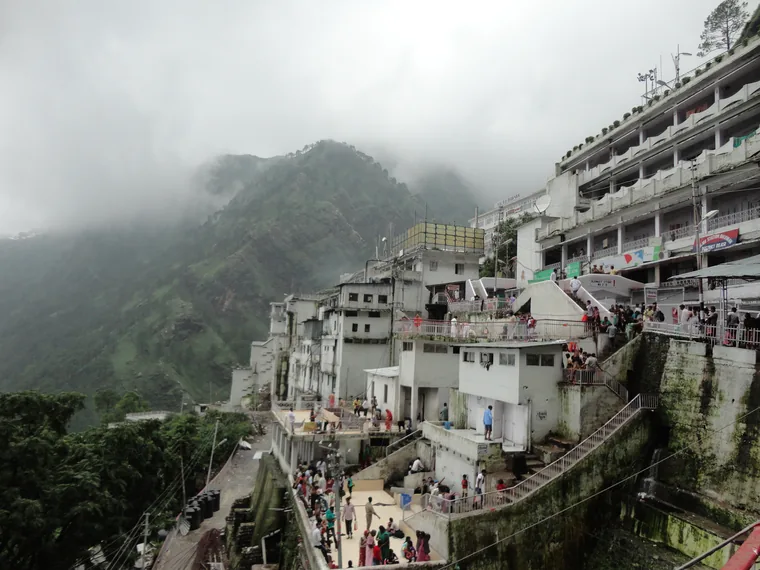
Photo: Raulcaeser, CC BY-SA 3.0
Vaishno Devi timings in short
A shrine that does not close, broken twice a day by an aarti whose timing follows the sun. The queue, the registration counters and the weather decide more of a visit here than any published hour.
History of Vaishno Devi Temple
The Shrine Board's own account of Vaishno Devi history centres on Pandit Sridhar, a poor Brahmin devotee from the village of Hansali at the foot of the Trikuta mountain. In the story the Board tells, the goddess appeared to him in a dream as a young girl and helped him hold a grand bhandara, or community feast, and later showed him the way to her cave. The Board says there is unanimity that the shrine was discovered by Pandit Sridhar around 700 years ago, and that inside the cave he found a rock form with three heads, the Holy Pindies worshipped today. Wikipedia, drawing on other traditions, places the revelation to Pandit Sridhar around the 10th century CE.
Wikipedia records older claims as well. The Mahabharata is said to mention Arjuna worshipping the goddess before the Kurukshetra war, with a verse referring to a goddess in 'Jambhu', read as ancient Jammu, and tradition holds that Guru Gobind Singh visited in 1672. The documentary record is firmer from 1846, when Maharaja Gulab Singh set up the Dharmarth Trust and the Vaishno Devi temple became part of it.
The hereditary Dharmarth Trust ran the shrine until 1986, when control passed to the Shri Mata Vaishno Devi Shrine Board under the then Governor, Jagmohan. The Board has managed the shrine and the yatra since then, and now records more than one crore pilgrims a year. The original cave is about 30 metres long, and Wikipedia notes that artificial tunnels have been built alongside it so that the far larger crowds of today can have darshan of the Pindies; the Board says the original cave is still opened for darshan in winter.
- Altitude
- 5,200 feet on the Trikuta mountain
- Trek
- Nearly 12 km from Katra
- Darshan
- Round the clock, all year
- Deity
- Three Holy Pindies, no idol
- Managed by
- Shrine Board, since 1986
- Pilgrims
- More than one crore a year
Why Vaishno Devi matters to Hindus
Vaishno Devi is worshipped as the Mother Goddess, and there is no statue or idol in the cave. Darshan is of three natural rock forms, the Holy Pindies, which the Board describes as manifesting the goddess in her three forms of Maha Kali, Maha Lakshmi and Maha Saraswati. The Board calls her the Mother who fulfils whatever her children wish for, and Wikipedia lists the shrine among the 108 Shakta pithas, sites dedicated to the worship of Shakti.
By legend, told by the Board, the goddess fled to the cave pursued by Bhairon Nath, a disciple of Guru Gorakhnath, and when he challenged her inside she took her divine form and cut off his head, which fell about 1.5 km away where the Bhairon temple now stands. That legend is why, as Wikipedia notes, a pilgrimage to Vaishno Devi is traditionally considered incomplete without a visit to the Bhairon Nath temple above Bhawan.
More facts about Vaishno Devi
- Deity
- Vaishno Devi, worshipped as three natural rock forms, the Holy Pindies, manifesting Maha Kali, Maha Lakshmi and Maha Saraswati
- Where
- A cave on the three-peaked Trikuta mountain above Katra, Reasi district, Jammu and Kashmir
- Altitude
- 5,200 feet
- The trek
- Nearly 12 km from the base camp at Katra
- Administered by
- Shri Mata Vaishno Devi Shrine Board, managing the shrine and the yatra since 1986
- Chairman
- The Lieutenant Governor of the Union Territory of Jammu and Kashmir, ex officio
- Annual footfall
- More than one crore pilgrims a year, as stated by the Board
- Daily capacity
- About 30,000 to 35,000 darshans a day
- Also known as
- Vaishno Devi Temple, Mata Vaishno Devi, Vaishno Devi Bhawan, Shri Mata Vaishno Devi Shrine, Trikuta Devi
Entry rules at Vaishno Devi
The Board sets these out as binding on every pilgrim. Registration is the one that decides whether a yatra happens at all.
Registration
All pilgrims without exception must register before the yatra. Registration is free, computerised, and done only by the Shrine Board, which states no other organisation is authorised to issue it.
RFID Yatra Access Card
Each pilgrim is photographed and issued a separate RFID Yatra Access Card, which is the documentary permission to proceed to the shrine.
Where to register
At the Yatra Registration Counter near the bus stand in Katra, at YRC-II about a kilometre away on the Udhampur road, or online.
Banganga check post
The first check post, at Banganga about 1.5 km from the counter, must be crossed within 6 hours of the card being issued. Otherwise the card is confiscated and a fresh one is needed.
No card
Pilgrims without a card are turned back at Banganga. Anyone found at Bhawan or en route without one is turned back and faces disciplinary action.
Waiting
When arrivals exceed what the mountain can hold, pilgrims are asked to wait at Katra and no registrations are issued until the waiting ends.
Phones and cameras
The Board's cloak room page states that video cameras, mobile phones and other electronic equipment are not allowed on the track for security reasons.
Inside the Holy Cave
Shoes, belts, combs and other items not allowed in the cave are deposited at the free cloak room opposite the main queue complex, Gate No. 1.
Hazardous items
Flammable substances, sharp objects and heavy, oversized or unauthorised luggage must not be carried on the trek.
Weather
No pilgrim shall proceed during adverse weather. Pilgrims are told to reschedule on IMD or District Administration alerts for heavy rain, cloudburst or landslides.
Routes
Only designated routes and tracks may be used. Shortcuts and unmarked trails are prohibited.
Vaishno Devi dress code
The Board publishes no dress code for the shrine. What it does publish is practical advice on clothing and footwear for a steep trek to 5,200 feet, and it is worth following.
- Heavy woollen clothing is needed in winter. For the rest of the year, light woollens are needed, because Bhawan stays cool at night even when Katra is hot and humid.
- Canvas shoes are advised. Fancy shoes make the track hard to walk, and footwear with flat or platform soles is recommended.
- Umbrellas and raincoats are needed in the rainy season.
- Blankets are available free of cost, so there is no need to carry them.
How to reach Vaishno Devi
By air
Fly to Jammu. The Shrine Board says air travellers must break their journey at Jammu and continue to Katra by road or rail; private taxis are available at Jammu airport.
By train
Trains run on to Katra, the base camp, via Bajalta, Sangar, Manwal, Ramnagar, Udhampur and Chak Rakhwal, so you can travel by rail from Jammu to Katra itself.
By road
Katra is about 50 km from Jammu. The Board gives around 2 hours by bus and 70 to 80 minutes by taxi, with buses every 10 to 15 minutes; the Katra road branches from the Srinagar road at Domel, about 35 km from Jammu.
Best time to visit Vaishno Devi
The Shrine Board is unusually direct about the best time to visit Vaishno Devi. It names the summer months of May, June and July, and the Chaitra and Sharad Navratras, as the peak rush periods, when pilgrims often wait 12 to 20 hours before darshan. It suggests the monsoon, with its waterfalls and greenery, and winter, when there is often snow and the original Holy Cave is open, as better times to go. As a rule of thumb it says a visit is more comfortable when daily numbers are below about 15,000 to 18,000.
Dress for the altitude whatever the season. Heavy woollens are needed in December and January, and light woollens the rest of the year, because Bhawan stays cool at night even when Katra is hot and humid. In the monsoon, carry an umbrella or raincoat and check Board and IMD advisories, since the yatra can be halted in heavy rain. Darshan itself runs round the clock, so the time of day matters less than avoiding the two aartis at sunrise and sunset, when darshan is paused for nearly two hours.
Tips before you go
- Register first and carry your own RFID Yatra Access Card; every pilgrim needs one and there is no charge.
- Cross the Banganga check post within 6 hours of the card being issued, or it is confiscated.
- Wear canvas shoes or flat-soled footwear for the steep track, and carry a walking stick if you need one.
- Do not pack blankets; the Board provides them free of cost.
- Leave shoes, belts and combs at the free cloak room opposite Gate No. 1 before entering the cave.
- Use only the designated tracks; shortcuts and unmarked trails are prohibited.
Getting a card, and getting up the hill
Two things decide how a Vaishno Devi yatra goes, and neither of them is a darshan timing: the registration system at Katra and the climb from Katra to Bhawan.
Why registration is compulsory
The Board explains that the Holy Pindies sit in a narrow cave where group visits are not possible, so darshan runs through a continuously moving queue and only a limited number of pilgrims can have darshan each day. It gives that limit as about 30,000 to 35,000. Registration is how it regulates the numbers on the track and at the shrine.
Registration also carries free accident insurance: Rs 3,00,000 for adults and Rs 1,00,000 for minors, valid only for accidental death and not for natural deaths including heart attacks. The Board names weekends in May and June, the second half of December and school and office holiday blocks as the times that usually bring waiting.
From Katra to Bhawan
The Board describes a trek of nearly 12 km from the base camp at Katra to the Holy Cave at 5,200 feet, and lists Bhawan at 13 km in its distance table, via Banganga, Charan Paduka, Adhkuwari, Himkoti and Sanjichhat. Bhairon Ghati lies beyond Bhawan at 6,619 feet.
An alternative track, opened in 1999, runs from just below Adhkuwari to just short of Bhawan. No ponies are allowed on it and it is 500 metres shorter than the old track. A battery vehicle runs on it, bookable for infirm, sick and disabled pilgrims at Inderprasth (Adhkuwari) and Manokamana Bhawan, subject to availability.
Not verified yet 7 items no official source publishes
- The clock times of the two aartis on any given day. The Board ties them to sunrise and sunset and publishes no times.
- Opening hours of the registration counters at Katra. The Board describes the counters but does not publish their hours on the pages read here.
- A newer RFID rule reported in the press, that the yatra must start within 10 hours of the card being issued and be completed within 24 hours. The Board's own registration page still states 6 hours to cross Banganga, and the newer rule has not been verified on an official page here.
- Whether the ban on mobile phones applies to the whole track today or only inside the cave complex. The Board's cloak room page states it applies to the track, but that page is several years old.
- Any dress code at the shrine itself. None is published on the pages read here.
- Helicopter and battery car fares, timings and booking rules.
- Whether the yatra is running on the day you travel. The Board suspends it in adverse weather and announces this through its site and its X account, @OfficialSMVDSB.
Know one of these from an official notice? Send it to us and the page is updated with a new date.
Questions about visiting
Answered from what the temple publishes, with the gaps left as gaps.
What are the Vaishno Devi darshan timings?
The Shri Mata Vaishno Devi Shrine Board states that darshan is open round the clock throughout the year. The only published pauses are the two aartis, just before sunrise and immediately after sunset, when darshan is suspended for nearly two hours.
Is registration compulsory for Vaishno Devi?
Yes. The Board states that all pilgrims without exception must register before the yatra. Registration is free, and each pilgrim is photographed and issued an RFID Yatra Access Card, which is the permission to go up to the shrine.
Where do I get the RFID Yatra Access Card?
At the Yatra Registration Counter near the bus stand in Katra, at a second counter called YRC-II about a kilometre away on the Udhampur road, or by registering online. The Board says no other organisation is authorised to issue it.
How long is the RFID card valid?
The Board's registration page states that the first check post at Banganga must be crossed within 6 hours of the card being issued, or the card is confiscated. Press reports describe a newer 10-hour and 24-hour rule, which has not been verified on an official page here.
What happens without a card?
The Board states that pilgrims without an RFID card are turned back from the Banganga check post. Anyone found at Bhawan or on the way without one is turned back and faces disciplinary action.
Does each family member need a card?
Yes. The Board states that a separate RFID Yatra Access Card is issued to each devotee.
Why might I be asked to wait at Katra?
The Board gives the most darshans the mountain can take in a day as about 30,000 to 35,000. When more pilgrims arrive, they are held at Katra and no registrations are issued until the waiting ends.
Is there a dress code at Vaishno Devi?
The Board publishes no dress code on the pages read here. It advises heavy woollens in winter, light woollens the rest of the year, canvas shoes or flat soles for the track, and raincoats in the rainy season.
Can I take my phone?
The Board's cloak room page states that video cameras, mobile phones and other electronic equipment are not allowed on the track for security reasons. How strictly that applies on the track today has not been verified here.
How long is the trek?
The Board describes a trek of nearly 12 km from Katra to the Holy Cave at 5,200 feet, and its distance table puts Bhawan at 13 km. An alternative track with no ponies runs from just below Adhkuwari and is 500 metres shorter.
Who runs the shrine?
The Shri Mata Vaishno Devi Shrine Board, which has managed the shrine and the yatra since 1986. The Lieutenant Governor of Jammu and Kashmir is its chairman by virtue of office.
Can I rely on this on the day I travel?
For registration rules and the shape of the day, yes. For whether the yatra is running, no: the Board suspends it in bad weather and announces that on its own site and its X account, @OfficialSMVDSB, which is the place to check.
Need the timings in full?
The timings page carries the whole published schedule, block by block, and what to check before you travel.