
Somnath Temple, Prabhas Patan
The first of the twelve Jyotirlinga shrines of Shiva, on the Arabian Sea coast in Gir Somnath district, run by the Shree Somnath Trust. The Trust publishes darshan from 6:00 AM to 10:00 PM, three aartis a day, and a light and sound show in the evening. Entry is free. The rule most likely to catch you out is not the dress code but the ban on electronics, which is absolute and includes phones and smartwatches.
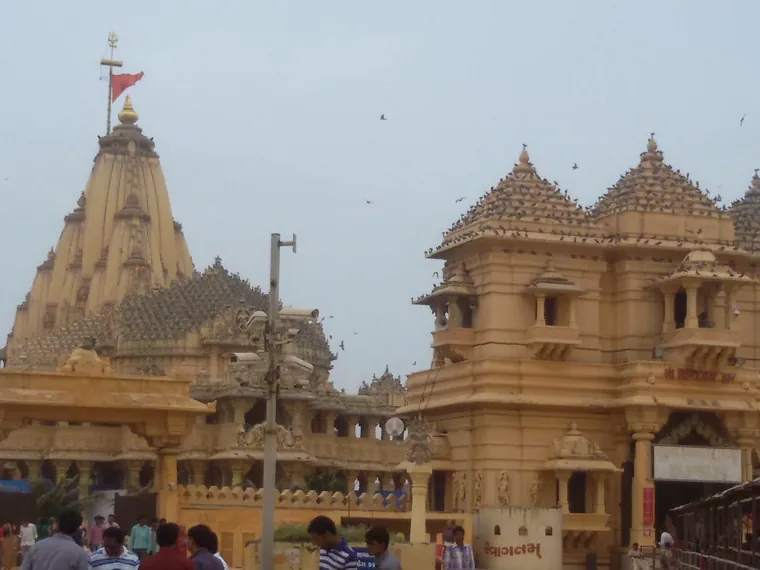
Photo: Aditya Mahar, CC BY-SA 4.0
Somnath timings in short
One long darshan window with three aartis inside it, and a light and sound show after dark that runs on its own schedule and stops for the monsoon.
History of Somnath Temple
Prabhas Patan was a place of pilgrimage long before the temple we see today. The Mahabharata and the Bhagavata Purana describe Prabhasa as a tirtha on the Saurashtra coast, and the name Someshvara appears in records from the 9th century. The Chaulukya king Mularaja is believed to have built a temple to Soma here some time before 997 CE, and excavations led by B. K. Thapar in 1950 and 1951 uncovered the foundations of a richly carved temple from the 9th or 10th century.
In January 1026 Mahmud of Ghazni raided the temple, desecrated the jyotirlinga and carried off the treasure of the temple and town. It was repaired and, in 1169 by an inscription's account, rebuilt in stone by King Kumarapala. The army of Alauddin Khalji sacked it again in 1299; the Chudasama king Mahipala I rebuilt it in 1308, and it was destroyed in 1395 by Zafar Khan and desecrated in 1451 by Mahmud Begada. Aurangzeb ordered its destruction in 1665 and again in 1706, when the order appears to have been carried out.
Around 1783 Ahilyabai Holkar built a separate, smaller temple near the ruins so that worship could continue; it still stands beside the main temple. After Junagadh State joined India, Vallabhbhai Patel visited the ruins in November 1947 and ordered the temple rebuilt. On Mahatma Gandhi's advice the money was raised from the public, and a trust headed by K. M. Munshi oversaw the work. The ruins were cleared in October 1950, and on 11 May 1951 President Rajendra Prasad performed the installation ceremony of the new temple.
- Status
- First of the twelve Jyotirlingas
- Consecrated
- 11 May 1951, by Rajendra Prasad
- Architecture
- Maru-Gurjara (Chaulukya) style
- Architect
- Prabhashankarbhai Oghadbhai Sompura
- Spire
- 15 m above the sanctum, 8.2 m flagpole
- Entry
- Free
Why Somnath matters to Hindus
Somnath is the first of the twelve Jyotirlinga shrines of Shiva, and it heads the list of jyotirlingas in the Shiva Purana. The name means Lord of Soma, the Moon. According to the legend the Shree Somnath Trust tells, the Moon married the twenty-seven daughters of Daksha Prajapati but favoured only Rohini. Daksha cursed him to lose his light, and on Brahma's advice the Moon came to Prabhas and worshipped Shiva, who freed him from the curse. Tradition also holds that the Moon built a golden temple here, Ravana a silver one and Krishna one of sandalwood.
The site is a Triveni Sangam, where the Kapila, Hiran and Saraswati rivers meet, and it is one of the five most revered seacoast pilgrimage places in India, with Dwarka, Puri, Rameswaram and Chidambaram. The Trust also describes Prabhas as the place from where Krishna took his last journey.
More facts about Somnath
- Deity
- Shiva
- Status
- The first among the twelve Jyotirlinga shrines of Shiva
- Where
- Prabhas Patan, Veraval town, Gir Somnath district, Gujarat
- Administered by
- Shree Somnath Trust
- Present temple
- Completed in May 1951
- Architecture
- Maru-Gurjara style of Hindu temple architecture
- Also known as
- Somnath Mandir, Somanath Temple, Shree Somnath, Somnath Jyotirlinga
Entry rules at Somnath
The electronics rule at Somnath is stricter than at most temples and is worth reading before you leave the hotel, not at the gate.
Electronics
All electronic and electric equipment and gadgets are strictly prohibited, including mobiles, cameras, smartwatches, laptops, tablets and calculators.
Entrance fee
Entrance is free of cost.
Footwear
Removed before entering. A free shoe house is available near the cloak room.
Prasad
The Trust runs online prasad booking through a separate site, somnathprasad.com.
Somnath dress code
The Trust publishes two rules about how you turn up, and one much stricter rule about what you carry.
- Mini skirts and disrespectful dress are not permitted.
- Smoking is not allowed within the vicinity of the temple at any time.
- Footwear must be removed before entering the temple. A shoe house is available near the cloak room and the service is free of cost.
How to reach Somnath Temple
By air
The Trust names Diu as the nearest airport, 85 km away, with Rajkot at 200 km and Ahmedabad at 390 km.
By train
The Trust gives Somnath railway station as 0.5 km from the temple and Veraval as 7 km.
By road
The temple is about 400 km south-west of Ahmedabad and 82 km south of Junagadh, on the coast at Veraval in Saurashtra.
Best time to visit Somnath
Veraval, the town Somnath stands in, is warm to hot through the year. Almost all its rain falls in the monsoon from June to September, often in short, intense storms, and the sea keeps temperatures less extreme than inland Saurashtra. The months after the monsoon are the drier choice, and the Trust's evening light and sound show does not run in the monsoon or rainy season, which is another reason to avoid June to September if you want to see it.
The Trust lists Shravan month, Shivratri, Golokdham Utsav, the five-day Kartik Purnima fair and Somnath Sthapana Divas among its major festivals, so expect heavier crowds on those dates. Because darshan runs from 06:00 to 22:00 with no published midday closure, any time of day works; the Trust also describes Vallabhghat within the complex as a sunset point, and the temple is lit up every evening.
Tips before you go
- Leave every electronic device, including phones and smartwatches, in the free cloak room lockers; all gadgets are prohibited.
- Photography is strictly prohibited. The Trust sells photographs at its souvenir counter instead.
- Wheelchairs and golf carts are available at the main gate for disabled and elderly visitors, and there is a lift inside the temple premises.
- A Trust-run Tirth Darshan bus to nearby temples leaves the main gate at 08:30 and 15:30 for a nominal charge.
- Avoid mini skirts, and do not smoke anywhere near the temple.
- Visit the Ahilyabai temple next door, built around 1783 to keep worship going when the main shrine lay in ruins.
Not verified yet 6 items no official source publishes
- Whether the aarti times shift with the season or on festival days. The Trust publishes them as fixed times without qualification.
- The price of the light and sound show, and whether it needs booking.
- Which months the Trust treats as the monsoon for the purpose of suspending the show.
- Cloak room opening hours, which matter because the electronics ban makes a cloak room visit compulsory.
- Whether any dress rule applies beyond the two the Trust states.
- Wheelchair access and any assisted route through the temple.
Know one of these from an official notice? Send it to us and the page is updated with a new date.
Questions about visiting
Answered from what the temple publishes, with the gaps left as gaps.
What are the Somnath Temple timings?
The Shree Somnath Trust publishes darshan from 6:00 AM to 10:00 PM. Unusually for a large temple, no midday closure is published, so the window runs continuously through the day.
When is aarti performed at Somnath?
The Trust publishes three aartis a day: 7:00 AM, 12:00 noon and 7:00 PM. They are published as fixed times rather than windows, and they fall inside the darshan block rather than closing it.
Is there an entry fee at Somnath?
No. The Trust states plainly that entrance is free of cost. Paid bookings on the Trust's own site are for rooms, pooja and prasad, and nothing about entering the temple is sold.
Can I take my phone into Somnath Temple?
No. The Trust prohibits all electronic and electric equipment, listing mobiles, cameras, smartwatches, laptops, tablets and calculators. This is stricter than at most temples and is the rule most likely to disrupt a visit.
Where do I leave my phone and shoes?
A cloak room handles belongings and a shoe house near it takes footwear, free of cost. Because the electronics ban is absolute, the cloak room stop is part of the visit rather than optional.
What is the dress code at Somnath?
The Trust states that mini skirts and disrespectful dress are not permitted. It also bans smoking within the vicinity of the temple at any time. No further dress detail is published.
What is the light and sound show?
An evening show the Trust runs from 8:00 PM to 9:00 PM, with one stated exception: it does not run in the monsoon or rainy season. Its price and whether it needs booking have not been verified here.
How do I get prasad from Somnath?
The Trust runs online prasad booking through a separate site, somnathprasad.com. What is distributed at the temple itself, and when, has not been verified here.
Where exactly is Somnath Temple?
At Prabhas Patan near Veraval town, in Gir Somnath district, Gujarat, on the Arabian Sea coast. The present temple was completed in May 1951 in the Maru-Gurjara style.
Who runs Somnath Temple?
The Shree Somnath Trust. Every timing and rule on this page comes from the Trust's own published answers rather than from a travel page.
Is Somnath one of the Jyotirlingas?
Yes. It is described as the first among the twelve Jyotirlinga shrines of Shiva, which is why it carries the footfall it does despite its distance from any large city.
Can I rely on these timings on the day?
They are standing hours rather than a daily schedule, which makes them more stable than most, but standing is not permanent. Festival days and temple events move them, and the Trust's own page is the place to confirm.
Need the timings in full?
The timings page carries the whole published schedule, block by block, and what to check before you travel.