Hindu temples in the United States
North American mandirs are built for visitors and publish accordingly, which makes them the easiest temples in this register to get right. The one covered here states its hours, its weekly closure, its dress code and its campus rules in its own words. Two things still catch people out: the closed day, and the fact that the dress code is enforced at the entrance rather than suggested on a sign.
Sources checked 1 September 2026
Temples covered in United States
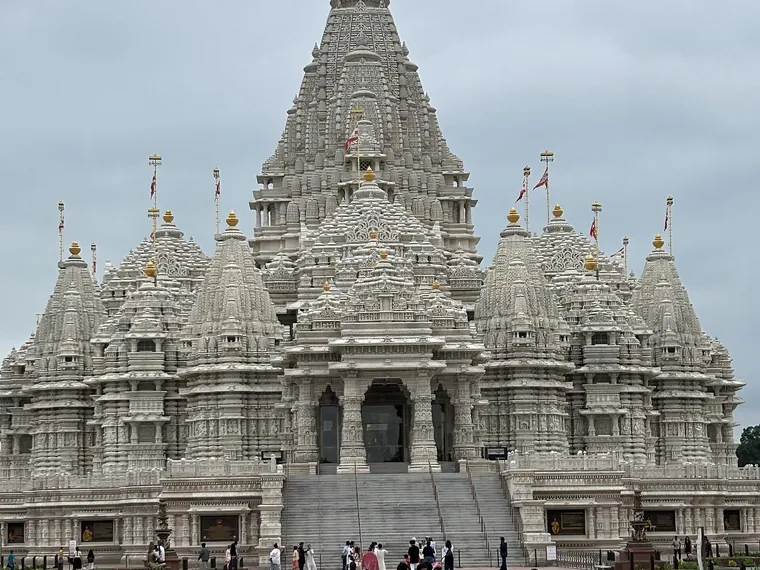
One temple so far. It joins the register as the largest Hindu mandir in the Western Hemisphere and one of the most searched Hindu sites in North America.
The hours, and the closed day
Standing hours with no seasonal variation and no midday closure, which is unlike almost every temple in South Asia. The weekly closure is the part worth carrying.
| Temple | Published hours |
|---|---|
| Akshardham New JerseyRobbinsville | 09:00 to 19:30, closed all day on Tuesdays. |
What is enforced at the entrance
Published as a plain list rather than left to judgement, which is the practical advantage of a mandir built with visitors in mind.
| Temple | The rule most likely to change your visit |
|---|---|
| Akshardham New JerseyRobbinsville | Dress code enforced at the entrance: shoulders, chest, back and knees covered. Large bags refused on campus. |
A published dress code is an enforced one. This mandir states that shoulders, chest, back and knees must be covered and that shorts, skirts and dresses above knee length are not permitted. Turning up in summer clothing and hoping for the best is the commonest way a visit here goes wrong.
What is different about visiting in the United States
Four things that separate an American mandir visit from one in South Asia, drawn from what this mandir publishes.
A weekly closed day, not a midday closure
The mandir is closed all day on Tuesdays, and the closure covers the entire campus including the Mahamandir. That is a different pattern from South Asia, where temples more often close for a few hours in the middle of every day and rarely for a whole day of the week.
A Tuesday drive to Robbinsville is a wasted one. It is the single most useful fact on the page and it is the one most likely to be missed.
The dress code is published and checked
No sleeveless or low-cut tops, no shorts, skirts or dresses above knee length, nothing revealing the shoulders, chest, back or knees, and nothing with offensive language or imagery. The mandir publishes those four rules plainly.
Where a South Asian temple often leaves dress standards unwritten and enforces them anyway, this one writes them down, which means there is no excuse for arriving unprepared.
Reservations on named days only
Free timed-entry reservations are required on six federal holidays and on Diwali: New Year's Day, Memorial Day, Independence Day, Labor Day, Thanksgiving and Christmas. On every other day no booking is needed.
Weekend and holiday reservation holders may enter no earlier than 30 minutes before and no later than 30 minutes after their slot, which is a narrower window than most visitors expect.
The campus rules are specific
No footwear inside the Mahamandir, no large bags on campus, no outside food or drink, no commercial photography, no drones, no pets other than service dogs, and no smoking, vaping, firearms, alcohol or drugs.
That level of specificity is unusual and useful. It means what is not on the list is a genuine question for the mandir rather than an unwritten rule you were expected to know.
Questions about American temples
Answered from what these temples publish, with the gaps left as gaps.
What are the hours?
Open 9am to 7:30pm every day except Tuesday, published as standing hours with no seasonal variation and no midday closure.
Which day is it closed?
Tuesday, and completely. The mandir states that the entire campus, including the Mahamandir, is closed. It is not a reduced-hours day.
What is the dress code?
No sleeveless or low-cut tops, no shorts, skirts or dresses above knee length, no clothing revealing the shoulders, chest, back or knees, and nothing with offensive language or imagery. It is enforced at the entrance.
Do I need a reservation?
Only on six federal holidays and on Diwali. They are free timed-entry reservations, and on every other day of the year none is needed.
How many American temples are covered?
One so far. The register grows by search demand rather than by region, and more North American mandirs are added as the answer gap justifies them.
Is there an entry fee?
No pricing appears on the mandir's visitor page. Entry is widely described as free, and this site has not confirmed that against the mandir, so it sits among the unverified items.
Can I take photographs?
Commercial photography and videography are prohibited and the campus is a no drone zone. Any restriction on personal photography inside buildings has not been verified here.
What can I not bring?
Large bags, outside food or drinks, pets other than service dogs, firearms or sharp weapons, alcohol or drugs. Smoking and vaping are also prohibited on campus.
Do I have to remove my shoes?
Inside the Mahamandir, yes. The published rule is specific to the Mahamandir rather than to the whole campus.
Is there a midday closure?
None published. The hours run continuously from 9am to 7:30pm, unlike most large temples in South Asia where a midday closure is normal.
Are aarti times published?
Not on the visitor page this site reads. If aarti matters to your visit, ask the mandir rather than relying on a third-party schedule.
Which American temple gets covered next?
Whichever readers ask for most and answers online serve worst. Sending a temple name and its town changes that order more than anything else does.
Temple in United States not covered yet?
Send its name and its town. Requests decide what gets written next, and corrections to a temple already here are published faster than anything else.