
Batu Caves Sri Subramaniar Temple
The Murugan cave temple above 272 steps at Gombak in Selangor, about 13 km north of Kuala Lumpur, under a statue 42.7 metres tall. This is the one temple on this site with no verifiable published schedule. The temple committee publishes no hours that could be checked, and the third-party sources that do publish hours disagree with each other. Rather than pick the most popular figure and print it as fact, this page sets out what is confirmed and what is not.
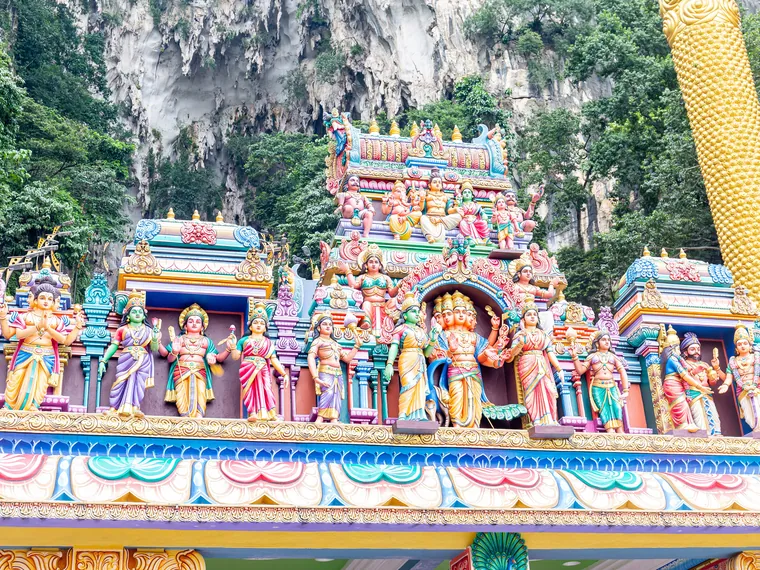
Photo: Wikimedia Commons, CC0
Batu Caves opening hours in short
What is verified about Batu Caves is the site, not the schedule. Three things hold regardless of what time the gate opens.
History of Batu Caves Temple
The rock is far older than the temple. Wikipedia explains that the limestone of Batu Caves formed more than 400 million years ago, but that the caves themselves probably began to form much later, 60 to 120 million years ago. The hill is a limestone mogote 325 metres tall, holding some 20 recognised caves. The name comes from the Malay word batu, rock, and in Tamil the site is called Pathu Malai.
People sheltered here long before it became a temple. Wikipedia records that the indigenous Temuan people, a tribe of Orang Asli, used the caves, and that Chinese settlers began digging guano from them in the 1860s for use as fertiliser. The American naturalist William Hornaday visited in 1878.
The Hindu temple owes its start to K. Thamboosamy, a Tamil trader who promoted the caves as a place of worship. According to Wikipedia, the shape of the cave entrance, which reminded him of Murugan's spear, the vel, is said to have inspired him. The temple to Murugan in the largest cave was completed in 1891, and the first Thaipusam festival was held there in 1892.
Reaching the temple got easier over time. At first pilgrims climbed the hill on foot. Wooden steps were built in 1920, and when they began to decay in the 1930s they were replaced in 1940 by the 272 concrete steps still used today. The golden statue of Murugan, 42.7 metres tall, was unveiled beside the steps in January 2006. In August 2018 the steps were repainted in bands of colour, and in 2024 plans were announced for an escalator and a multi-purpose hall at the foot of the hill.
- Deity
- Murugan
- Temple completed
- 1891
- First Thaipusam
- 1892
- Steps
- 272 concrete steps, built in 1940
- Murugan statue
- 42.7 m, unveiled January 2006
- Limestone
- Formed over 400 million years ago
Why Batu Caves matters to Hindus
Batu Caves is a temple to Murugan, and it is the focal point of Thaipusam in Malaysia. On Thaipusam, as Wikipedia describes it, devotees carry kavadi, burdens that range from a simple wooden or steel frame on the shoulders to the vel kavadi, an altar fixed to the body with skewers and hooks. Many carry pots of milk as offerings. Devotees usually prepare for 48 days with prayer, a vegetarian diet, fasting and celibacy.
The festival begins in Kuala Lumpur. A procession leaves the Sri Mahamariamman Temple in the early morning with a silver chariot carrying Murugan and his consorts, Valli and Deivanai. After a ritual bath in the nearby Sungai Batu river, devotees climb to the temple. The silver chariot, Wikipedia notes, first appeared in 1983 and was built with 350 kilograms of silver.
The site is more than one shrine. At the foot of the hill, the Cave Villa complex of the Art Gallery Cave and Museum Cave shows statues and paintings from Hindu mythology, most about Murugan. The Ramayana Cave, to the left, has paintings of the Ramayana and a Hanuman statue 15 metres tall at its entrance, beside a Hanuman temple opened in November 2001.
More facts about Batu Caves
- Deity
- Murugan
- Where
- Gombak, Selangor, about 13 km (8.1 mi) north of Kuala Lumpur
- Steps
- 272 concrete steps, constructed in 1940
- Statue
- 42.7 m (140 ft) tall, among the tallest Murugan statues in the world
- The hill
- A 325 m (1,066 ft) tall limestone mogote
- Managed by
- A temple committee oversees maintenance and development
- Also known as
- Batu Caves, Batu Caves Murugan Temple, Sri Subramaniar Swamy Temple, Batu Malai Sri Murugan Temple
How to reach Batu Caves Temple
By train
Take the commuter train from KL Sentral in Kuala Lumpur to Batu Caves Komuter station.
By train
Batu Caves station is the northern terminus of the Batu Caves–Pulau Sebang Line, which runs through KL Sentral.
By train
The station was redeveloped and reopened in August 2010. Batu Caves is listed as the landmark next to it.
By road
Batu Caves is at Gombak in Selangor, about 13 km north of Kuala Lumpur. Bus 11 runs from the Bangkok Bank stop near Central Market, or you can drive.
Best time to visit Batu Caves
No temple timetable could be verified, so the best time to visit comes down to the crowds and the climb. Thaipusam is the biggest day of the year. Wikipedia describes thousands of people and a procession that sets out early in the morning from Kuala Lumpur. If you want to see the kavadi and the pilgrims, that is the day to come. If you want a calm visit and room on the steps, choose another day.
On any other day, the 272 steps up to the cave temple are the main effort, and they are open to the sky. Since no closing time has been confirmed, arriving early in the day is the safer plan. Allow time for the Ramayana Cave and the Cave Villa at the foot of the hill as well.
Tips before you go
- The commuter train ends at Batu Caves station, so you cannot miss your stop coming from KL Sentral.
- Keep food out of sight. Long-tailed macaques live on the site, rely on people for food and can be a nuisance.
- Do not expect to wander into the inner caves. Access is restricted to protect the ecology, and visits are by educational trips run by the Malaysian Nature Society.
- Take the climb slowly: there are 272 steps up to the cave temple.
- On Thaipusam, expect a procession arriving from the Sri Mahamariamman Temple in Kuala Lumpur and very large crowds.
Not verified yet 6 items no official source publishes
- The opening and closing times. No schedule published by the temple could be verified, and the third-party figures in circulation disagree.
- Aarti or pooja times of any kind.
- Whether an entry fee applies to the main cave temple, and to the other caves on the site.
- The dress code, which is enforced at many Malaysian temples but is not published here in a form this site could check.
- Whether photography, bags or footwear are restricted.
- Thaipusam arrangements, which replace the ordinary schedule entirely.
Know one of these from an official notice? Send it to us and the page is updated with a new date.
Questions about visiting
Answered from what the temple publishes, with the gaps left as gaps.
What are the Batu Caves opening hours?
This page does not print any, because none published by the temple could be verified. The figures circulating elsewhere, mostly 6:00 to 21:00 or 7:00 to 21:00, come from travel and listing sites, disagree with each other, and carry no date.
Why will you not just print the common figure?
Because a number repeated by many pages is not the same as a number anybody checked. Copying it here would add one more undated claim to the pile and make it look more official than it is.
So how do I find out the hours?
Ask locally before you go, or plan around daylight and treat the site as a place you visit in the morning. If you find something published by the temple itself, send it and this page changes the same week.
How many steps are there?
272 concrete steps, constructed in 1940, leading from the forecourt to the cave temple inside the limestone hill.
How tall is the Murugan statue?
42.7 metres, about 140 feet, standing at the foot of the steps. It is among the tallest Murugan statues in the world.
Where exactly is it?
At Gombak in Selangor, about 13 kilometres, or 8.1 miles, north of Kuala Lumpur. The caves are inside a limestone mogote 325 metres tall.
Is there an entry fee?
Not verified. Entry to the main cave temple is widely described as free, but this site has not confirmed that against the temple, and other caves on the site are reported to charge separately.
Is there a dress code?
Not published in a form this site could verify. Dress codes are commonly enforced at Malaysian Hindu temples, so cover shoulders and knees and expect to be stopped if you do not.
What is Thaipusam like here?
Batu Caves is the focal point of Thaipusam in Malaysia. Whatever the ordinary hours are, they do not describe those days, and neither the crowd size nor the arrangements have been verified here.
Who runs the temple?
A temple committee oversees maintenance and development. This site has not found a published contact or schedule from that committee, which is why the timings gap exists.
Is this page useless without the hours?
It tells you the one thing the other pages will not: that nobody has checked their number either. Knowing that a timing is unverified changes how you plan, which is more useful than a confident figure that might be wrong.
How do I help fix this?
Photograph the notice board at the entrance and send it. A photograph of a temple's own sign is the strongest source there is, and it would turn this page from a gap into an answer.
Need the opening hours in full?
The opening hours page carries the whole published schedule, block by block, and what to check before you travel.