
BAPS Shri Swaminarayan Mandir, Neasden
Europe's first traditional Hindu stone mandir, opened in Neasden in 1995 and built from 26,300 carved stone pieces. The Mandir and Haveli are open 9.00am to 6.00pm throughout the year, including Bank Holidays, with admission free. The distinction worth understanding before you come is that opening hours and murti darshan windows are not the same thing: the building is open longer than the shrine is viewable.
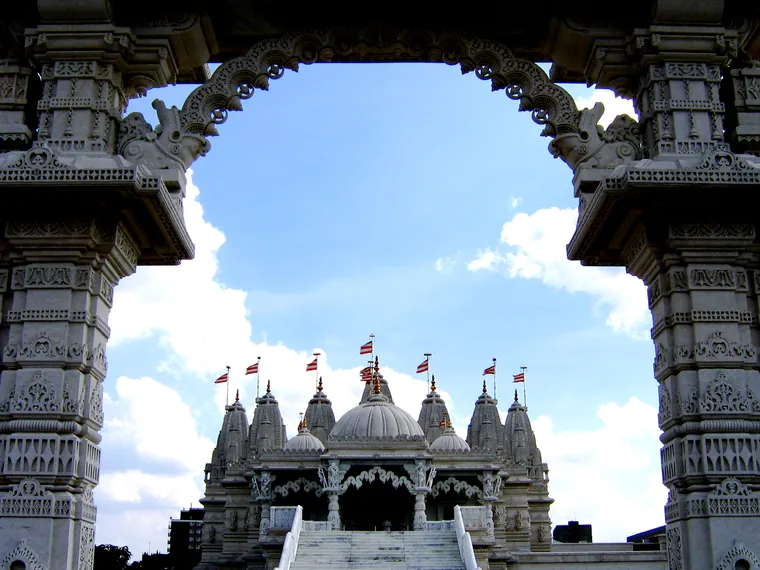
Photo: C. G. P. Grey, CC BY 2.0
Neasden Mandir opening times in short
One opening window, three darshan windows inside it, and one arti. Confusing the first with the second is the commonest disappointment here.
History of Neasden Temple
BAPS worship in London began in June 1970, in a converted church in Islington, north London. By 1982 the congregation had outgrown it and moved to a warehouse in Neasden, and in 1990 plans were drawn up for a permanent, traditionally built mandir.
Planning permission was granted in August 1992 and work began that November. On 24 November 1992, 4,500 tonnes of concrete were poured for the foundations in 24 hours, described as the largest concrete pour in UK history. The first stone was laid in June 1993. The Italian marble was shipped to Kandla in India for carving, and the finished pieces were sent to London and reassembled like a giant jigsaw, with no ferrous materials in the stonework.
About 450 craftsmen, 100 full-time volunteers and more than 1,000 part-time volunteers worked on the project, which cost £12 million. The mandir was completed on 20 August 1995 and inaugurated that year by Pramukh Swami Maharaj. In 2000 Guinness World Records listed it as the largest traditionally built Hindu temple outside India, a record later BAPS mandirs have since overtaken. Charles and Camilla visited in 2009 for Holi and, as King and Queen, returned on 29 October 2025 to mark its 30th anniversary.
- Completed
- 20 August 1995
- Style
- Stone mandir inspired by Delwara, Mount Abu
- Pinnacles and domes
- 7 shikhars and 6 domes
- Carved stone
- 26,300 pieces
- Admission
- Free
- Daily artis
- Five, from 6.00am to 8.00pm
Why Neasden Temple matters to Hindus
The mandir houses murtis of Bhagwan Swaminarayan, Radha and Krishna, Rama and Sita, and Shiva and Parvati. Its own account places it in a long Hindu tradition of worshipping the divine through murtis enshrined in mandirs, and quotes Bhagwan Swaminarayan's sermon of 25 November 1822, in which he said he built mandirs so that upasana, correct theological worship, would be upheld.
The mandir describes itself as a place where a consistent pattern of rituals is observed every day, where young and old can learn about Hindu beliefs and values, where festivals are celebrated through the year, and where dialogue fosters respect between people of different faiths. Its day is built around five artis, the ceremony of light, from Mangala Arti at 6.00am to Shayan Arti at 8.00pm, each tied to a part of the deities' daily routine.
For Hindus in Britain it is also a landmark in its own right: Europe's first traditional Hindu stone temple, as distinct from a converted secular building, and largely built by the community's own volunteers.
More facts about Neasden Mandir
- Where
- Neasden, London, England, in the NW10 postcode area
- Opened
- Completed 20 August 1995 and inaugurated in 1995 by Pramukh Swami Maharaj
- European first
- Europe's first traditional Hindu stone temple, as distinct from converted secular buildings
- Exterior stone
- 990 cubic metres (35,000 cubic feet) of Bulgarian limestone
- Interior stone
- 700 cubic metres (25,000 cubic feet) of Indian and Italian marble, carved at Kandla in India and shipped to London
- Stone pieces
- 26,300 carved stone pieces
- Dimensions
- 21 metres (70 feet) high and 60 metres (195 feet) long, covering 1.5 acres
- Also known as
- Neasden Temple, BAPS Shri Swaminarayan Mandir London, Neasden Mandir, Swaminarayan Mandir London
Entry rules at Neasden Mandir
The mandir publishes clear rules on what may be carried in and what may be photographed.
Admission
Free.
Photography
Mobile phone photos for personal use only are permitted outdoors at ground level. No photography or filming is allowed inside buildings. Commercial use requires written permission.
Bags and cameras
Large bags and cameras must be deposited in the baggage cabin before entering.
Prohibited items
Sharp objects, dangerous materials and incendiary items including knives, matches and lighters.
Time to allow
The mandir suggests allowing at least 2 hours for a complete tour.
Neasden Mandir dress code
Quoted from the mandir's own visitor guidelines rather than paraphrased.
- Tops must cover the shoulders, chest, navel, and upper arms.
- Leg-wear must be at least below knee-length.
- Shoes are removed when entering the Haveli complex. Shoe racks are provided.
How to reach Neasden Temple
By train
Four Underground stations are within reach. From Wembley Park (Metropolitan and Jubilee lines), bus 206 from Stop O drops you at Stop J on Brentfield Road, opposite the mandir. Stonebridge Park (Bakerloo line and London Overground) is a 15 to 18 minute walk or a short ride on bus 112, Harlesden (Bakerloo line and London Overground) about a 20 minute walk or a ride on bus 206 or 224, and Neasden (Jubilee line) about a 20 minute walk.
By road
Buses 206 and 224 stop on Brentfield Road outside the mandir. By car from the M1, leave at junction 1 (Staples Corner), follow the A406 North Circular for about 2 miles past Tesco and IKEA, and turn left at the lights onto Brentfield Road. From the M4 or A40, follow the A406 to the Hanger Lane Gyratory and the brown Neasden Temple signs. The address is Pramukh Swami Road, Neasden, London NW10 8HW.
Best time to visit Neasden Temple
Come in the morning if you want to see the murtis as well as the building. The Mandir and Haveli are open 9.00am to 6.00pm every day, including Bank Holidays, but murti darshan runs only from 9.00 to 11.00am, from 11.45am to 12.15pm, and in the afternoon from 4.00pm on weekdays or 3.30pm at weekends and on Bank Holidays. Arriving before 11.45am also lets you attend Rajbhog Arti, the arti the mandir says visitors are welcome to attend.
The mandir suggests allowing at least two hours for a complete tour. Festival days bring the largest crowds and the most colour: Diwali and the Hindu New Year Annakut, with its grand offering of food to the deities, and other major festivals that are accompanied by evening assemblies. The mandir warns that because of its many special services, timings and access can change without notice, so check before travelling on or around those dates.
Tips before you go
- Wear a top that covers the shoulders, chest, navel and upper arms, and leg-wear that reaches below the knee.
- Take photographs only outdoors at ground level on a mobile phone, as no photography or filming is allowed inside the buildings.
- Leave large bags and cameras in the baggage cabin before going in.
- Do not bring knives, matches, lighters or any other sharp, dangerous or incendiary items.
- Expect to take your shoes off on entering the Haveli complex, where shoe racks are provided.
- For the shortest walk, take bus 206 from Wembley Park station to the stop opposite the mandir on Brentfield Road.
Not verified yet 5 items no official source publishes
- Whether the exhibition is ticketed, and at what price.
- Whether darshan windows change during festivals such as Diwali and Annakut, when the mandir is at its busiest.
- Parking arrangements and whether they are charged.
- Whether prasad is available, where and when.
- How the dress code is applied in practice, and whether any covering is lent at the entrance.
Know one of these from an official notice? Send it to us and the page is updated with a new date.
Questions about visiting
Answered from what the temple publishes, with the gaps left as gaps.
What are the Neasden Temple opening hours?
The Mandir and Haveli are usually open to the public from 9.00am to 6.00pm throughout the year, including Bank Holidays. Admission is free.
Are opening hours the same as darshan times?
No, and this is the most useful distinction on the page. The building is open nine hours a day, but murti darshan runs in three windows: 9.00 to 11.00am, 11.45am to 12.15pm, and 4.00 to 6.00pm on weekdays.
Do weekend times differ?
Yes, for the afternoon darshan window. On weekends and Bank Holidays it starts at 3.30pm rather than 4.00pm, running to 6.00pm either way.
When is arti?
The mandir's arti page lists five a day: Mangala Arti at 6.00am, Shangar Arti at 7.30am, Rajbhog Arti at 11.45am, Sandhya Arti at 7.00pm and Shayan Arti at 8.00pm. Rajbhog Arti is the one it says visitors are welcome to attend.
What is the dress code?
Tops must cover the shoulders, chest, navel and upper arms, and leg-wear must be at least below knee-length. Shoes are removed on entering the Haveli complex, where racks are provided.
Can I take photographs?
Mobile phone photos for personal use are permitted outdoors at ground level only. No photography or filming is allowed inside the buildings, and commercial use needs written permission.
What can I not bring?
Sharp objects, dangerous materials and incendiary items such as knives, matches and lighters. Large bags and cameras must be deposited in the baggage cabin before entering.
Is there an admission charge?
No. Admission is free. The mandir suggests allowing at least two hours for a complete tour.
What makes this mandir significant?
It is described as Europe's first traditional Hindu stone temple, as distinct from a converted secular building. It was completed on 20 August 1995 and inaugurated that year by Pramukh Swami Maharaj.
What is it built from?
990 cubic metres of Bulgarian limestone outside and 700 cubic metres of Indian and Italian marble inside, in 26,300 carved stone pieces. The marble was sent to Kandla in India to be carved and then shipped to London.
How big is it?
21 metres, about 70 feet, high and 60 metres, about 195 feet, long, covering 1.5 acres of land.
Can I rely on these timings?
The mandir itself says not entirely. It states that because of the many special services throughout the year, timings and access to any part of the Mandir are subject to change, sometimes unavoidably without notice.
Need the opening times in full?
The opening times page carries the whole published schedule, block by block, and what to check before you travel.